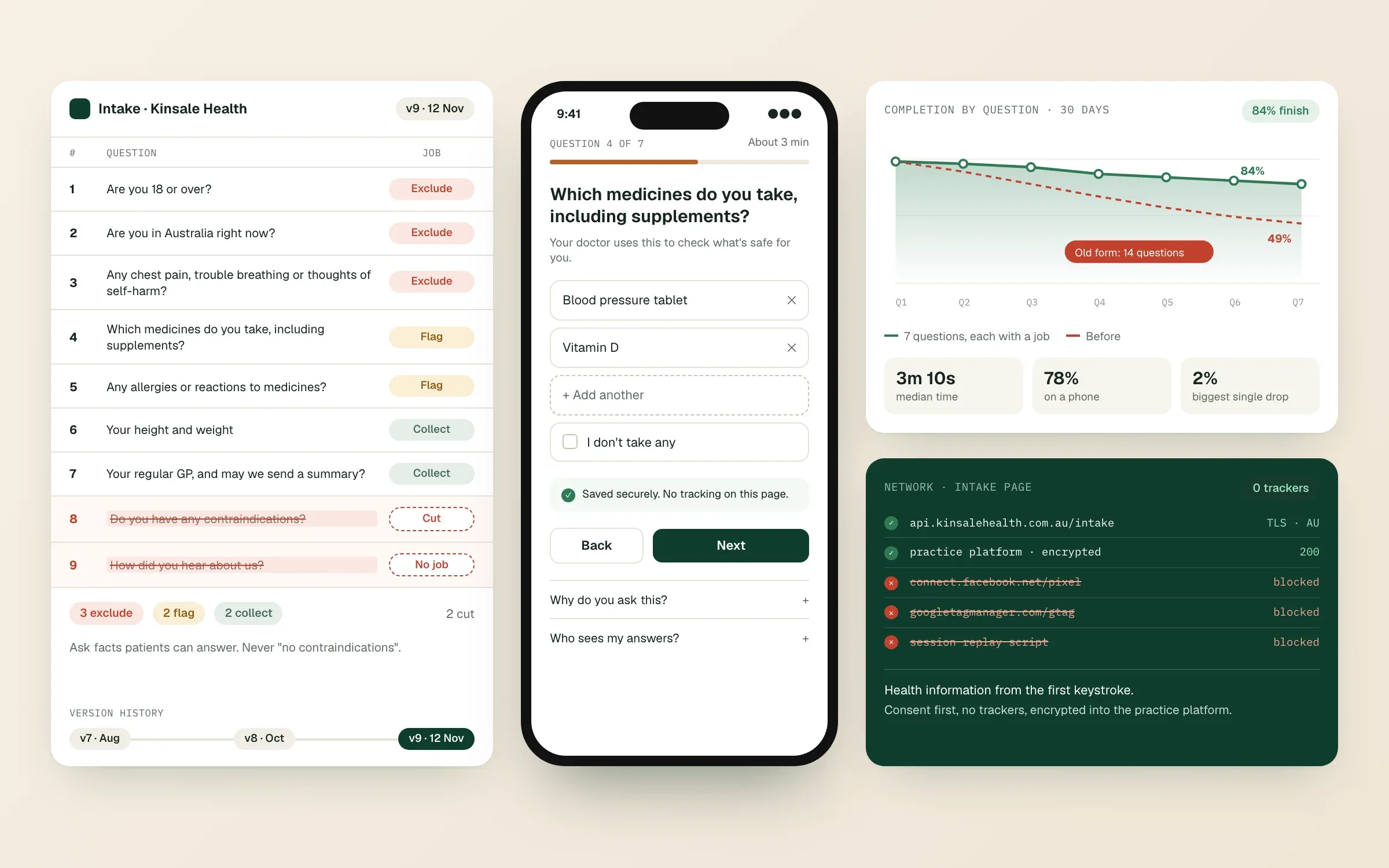
We've built prescreening questionnaires for GP telehealth, weight management, peptide, longevity and medical cannabis clinics. The ones that work have something in common: they're short enough that real patients finish them, strict enough that the practitioner isn't surprised in the consultation, and worded so nobody could read them as a vending machine for prescriptions. This read is how we get there, from the first question list to the test plan.
What is the questionnaire actually for?
Three things, and only three:
- Stop people who clearly can't be helped through telehealth for this service, before they pay.
- Flag risks so the practitioner knows what to look at.
- Collect history so the consultation is safer and faster.
It is not where treatment is decided. The Medical Board doesn't support prescribing without a real-time consultation, and its telehealth guidelines say questionnaire-based tools without a real-time consultation are not good practice. That shapes every word on the screen. Our read on booking flows that meet Medical Board guidelines covers the rest of the journey.
Every question needs a job
We sort every question into one of three outcomes before we design a single screen:
- Exclude: this answer means the person can't continue through telehealth for this service. Under 18, outside Australia, emergency symptoms.
- Flag: they can continue, but the practitioner needs to see this. A stable mental health condition, several medicines, a heart history.
- Collect: neutral information for the record. Height, weight, current medicines, allergies, GP details.
If a question doesn't fit one of those, it's usually there because someone thought it might be useful. Cut it. The full logic, with examples for different pathways, is in our read on telehealth eligibility questionnaire logic.
The shared screening block
Almost every pathway starts with the same core, which we keep identical across services so it's tested once and trusted:
| Question | Outcome |
|---|---|
| Age 18 or over | Exclude if under 18 |
| Currently located in Australia | Exclude if not |
| Emergency symptoms (chest pain, trouble breathing, thoughts of self-harm) | Exclude, with emergency and crisis signposting |
| Pregnant, breastfeeding or planning pregnancy | Exclude or flag, depending on the service |
| Current medicines, including supplements | Collect, and flag interacting classes |
| Allergies and adverse reactions (asked once) | Collect |
| Medical conditions | Flag or exclude, depending on the service |
| Mental health history | Flag (exclude for some pathways) |
| Alcohol and other substance use | Flag |
| Regular GP and consent to share a summary | Collect |
| Height and weight | Collect |
| Acknowledgements: no guarantee of treatment, consultation required, accurate answers | Required to continue |
Then each service adds its own block. A peptide or longevity pathway asks about cancer history, diabetes, anti-doping testing, previous unprescribed use and comfort with self-injection. A medical cannabis pathway asks about psychosis history (personal and family), age under 25, driving and safety-sensitive work, and drug testing at work.
Wording rules we never break
Small words carry legal weight here. Our rules:
- The result is "eligible to book a consultation". Never "approved", "eligible for treatment" or "you qualify for [medicine]".
- No impossible declarations. "I confirm I have no contraindications" asks a patient to make a clinical judgement. Ask what they take and what they've been diagnosed with instead.
- No implied decisions. "Upload a photo and we'll prescribe" is a serious problem. Photos inform the consultation; they don't replace it.
- Prices match the booking flow. If the questionnaire shows a fee, it must be the same fee the patient pays.
- Don't mention tests you don't arrange. If the flow never organises pathology, don't ask "have you completed your blood test?"
Designing for completion
A safe questionnaire nobody finishes helps no one. What moves completion rates in our builds:
- One question per screen on mobile, with large tap targets and a visible progress bar.
- Plain language. "Do you take any medicines, vitamins or supplements?" beats "List current pharmacotherapy".
- Branching, so people only see questions that apply to them.
- Exclusions shown at the end, not mid-way. Stopping someone after one answer invites them to go back and change it; showing the outcome at the end gives the practitioner a full picture and reduces answer gaming.
- Kind exclusion screens. Explain that telehealth isn't the right route, suggest seeing their regular GP, and show 000 and crisis lines where relevant. A good exclusion screen protects the patient and the clinic's reputation.
- Save progress, so a patient interrupted halfway doesn't start again.
How we build it
We keep questionnaire logic out of page templates. Each pathway is a versioned configuration (we use a JSON schema): questions, answer types, branching rules and outcomes. The front end renders whatever the configuration says. That means:
- A clinician can review the questionnaire as a readable document, not as code.
- Changing a question doesn't need a redesign.
- Every version is dated, so you can always say which rules applied to a patient on a given day. From 10 December 2026 that matters for privacy disclosures too; see automated eligibility screening and the December 2026 privacy rules.
Answers go from the browser to our backend over HTTPS, then into the practice platform's record (Cliniko, Halaxy or MediRecords), so the practitioner sees them before the call.
Privacy from the first keystroke
- Ask for consent before the first health question, with a short notice linking to the privacy policy.
- No analytics tags, ad pixels or session recording on questionnaire screens.
- No answers in email, spreadsheets or form plugins that store data overseas.
- Store only what the practitioner needs.
How we test it
We've seen questionnaires go live that marked every single patient ineligible, and forms that threw a server error on submit. Both are avoidable. Before launch we:
// checklist0 of 6 done
Want us to design or review yours? Start a brief on Connect.
Sources
All checked 21 Nov 2026.
- Telehealth consultations with patients, Medical Board of Australia
Finished this read?
- OpenedToday
- FinishedNot yet
Written by
Kevin MatthewsHead of Development
Kevin leads engineering at SingletonTec and has spent 10+ years building production-grade websites, apps and systems for businesses.