From 10 December 2026, Australian clinics covered by the Privacy Act must explain in their privacy policy when a computer program uses personal information to make, or substantially and directly help make, decisions that could significantly affect patients. For a telehealth clinic, the most likely example is online eligibility screening: a questionnaire that decides who can book. This read explains how the new rule works, where it touches a typical clinic platform, and what we change in the system so your privacy adviser can write an accurate disclosure. It is written by the team that builds these platforms, not by lawyers, so treat it as a technical starting point and have your adviser confirm how the rule applies to you.
What changes on 10 December 2026?
Your privacy policy gains a new required section whenever software plays a real part in significant decisions about patients. The change comes from the Privacy and Other Legislation Amendment Act 2024, which added new rules to Australian Privacy Principle 1 (APP 1.7 to 1.9). The OAIC's APP 1 guidance confirms they start on 10 December 2026.
Does this apply to a small clinic?
Yes, in almost every case. The Privacy Act's small business exemption does not cover businesses that provide a health service and hold health information, so clinics are covered regardless of turnover.
Does a human sign-off take it out of scope?
Not automatically. The rule covers programs that do something "substantially and directly" related to the decision, not only fully automated ones. The OAIC has said that systems which materially assist a human decision-maker may still be captured. Commentators reading the law's explanatory notes describe "substantially" as the program being a key factor in the human's decision, and "directly" as a direct connection to it.
What about data you collected before December?
The rule looks at decisions made after 10 December 2026, even if the personal information was collected earlier or the program was already running. An existing questionnaire is not exempt because it launched last year.
Is your telehealth eligibility screening a "decision" under the new rules?
It can be, because the law's own examples include access to healthcare. The explanatory notes list decisions affecting access to a significant service or support, and give access to healthcare services as an example. A questionnaire that stops a patient booking a telehealth consult is a program deciding access to a health service.
We build eligibility questionnaires on a three-outcome model: Exclude, Flag, Collect (the full logic is in our read on telehealth eligibility questionnaire logic). Each outcome lands differently under the new rule.
| Questionnaire outcome | What the program does | How it likely sits under the new rule |
|---|---|---|
| Exclude (for example under 18, outside Australia, emergency symptoms) | Stops the patient booking, on its own | Likely in scope: a decision made solely by the program, affecting access to a health service |
| Flag (for example a medicine that interacts, a mental health history) | Highlights a risk for the practitioner to assess | Possibly in scope: depends how much the practitioner relies on the flag, and whether flags change who gets seen or how fast |
| Collect (for example height, current medicines, GP details) | Stores information for the consult | Usually out of scope on its own: no decision is made |
The practitioner's real-time consultation still makes the clinical decision. That is good practice under the Medical Board telehealth guidelines, but it does not cancel out the program's earlier decision to let someone book or not.
Where else does automation decide things on a clinic platform?
Eligibility screening is the obvious one, but most telehealth platforms we build or audit have several other automated rules. Each should go on your map so your adviser can decide whether it is significant.
| Automation | Example rule | Why it might matter |
|---|---|---|
| Repeat script eligibility | Patient can request a repeat only if their last consult was within a set period | Controls access to ongoing care |
| Identity verification | Booking blocked if ID or Medicare details fail an automated check | Can refuse service |
| No-show and late cancellation | Account restricted or fee charged after two no-shows | Affects access and money |
| Refunds | Automatic refund approved or declined based on timing | Affects the patient's rights under the contract |
| Payment risk | Card flagged and booking held by a payment provider's fraud rules | Can refuse or delay service; arranged through a vendor |
| Triage or waitlist ordering | Patients sorted by answers or urgency score | Shapes who is seen first |
| AI chat or symptom tools | Chatbot suggests a service or tells someone they are not suitable | Can steer access to care |
Some of these run inside third-party tools rather than code we write, such as a practice management system's booking rules or a payment provider's fraud screening. The rule still applies to you if you arranged for the program to be used in your decisions, so vendor features belong on the map too.
What do we change in the system?
The policy can only be accurate if the system can explain itself. These are the changes we make on telehealth platforms so a clinic can answer "what does our software decide, and on what data?" with evidence, not guesses.
1. A decision map
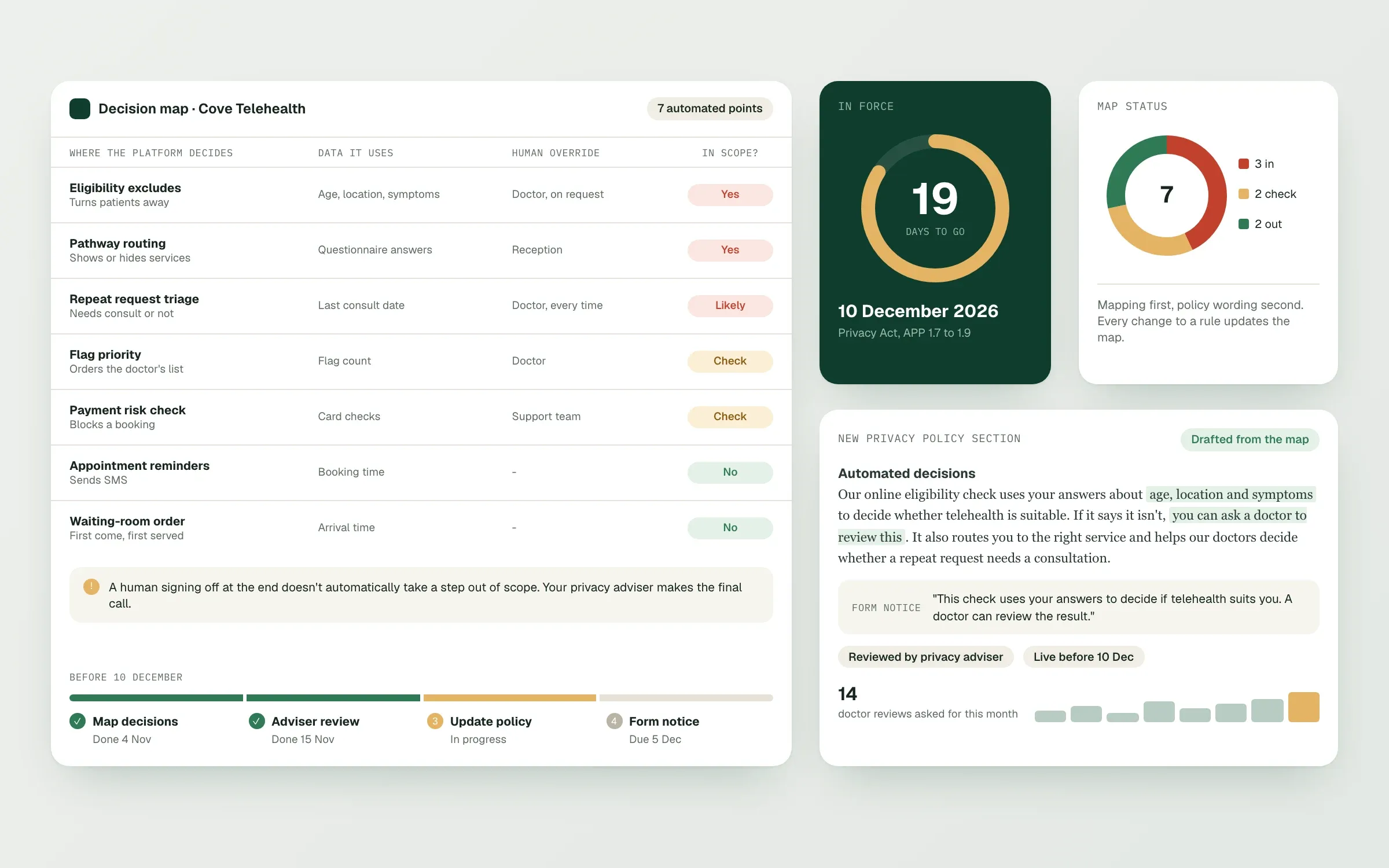
We list every rule that can stop, delay, charge or prioritise a patient, with five columns: the trigger, the personal information it reads, the outcome, who can override it, and where it runs (our code or a vendor's). This is the document your adviser works from, and it matches the first steps commentators recommend: map decisions, then record each decision pathway.
2. Versioned eligibility logic
Questionnaire rules live in a versioned configuration (we use a JSON schema per pathway) rather than being hard-coded across pages. Every change gets a version number and date. When a patient asks why they could not book on 3 March, you can see exactly which rules applied that day.
3. An outcome log
For each submission we record the rule version, the outcome (excluded, flagged or passed) and which rule triggered it. The log stores rule identifiers and outcomes, not a second copy of the patient's health answers, so it does not create a new privacy risk while answering the transparency one.
4. A human review route
Every exclusion screen gets a clear next step: see your regular GP, call the clinic, or ask for a review. Where the clinic wants it, an "ask a practitioner to review" option lets staff override the outcome, with the override logged. This does not take the process out of scope, but it shows the program is not the last word and gives patients a fair way through.
5. A collection notice where the data is collected
The privacy policy is the high-level document; patients also need a short notice at the start of the questionnaire about what is collected and why (APP 5). We add a plain-English notice, linked to the full policy, before the first health question. Our read on telehealth prescreening questionnaire design covers the rest of the form.
6. Vendor questions answered
For each third-party tool on the map (booking platform, payment provider, ID check, chatbot), we record what automated decisions it makes on your behalf and where the setting lives. Some vendors document this well; others need asking. Your adviser will want those answers in writing.
What goes in the privacy policy?
Where the rule applies, the policy must describe three things in plain language:
- The kinds of personal information used by the program.
- The kinds of decisions made solely by the program.
- The kinds of decisions where the program does something substantially and directly related to making the decision.
It does not need to reveal commercial-in-confidence detail such as your exact rules or scoring.
This is the kind of input we hand a clinic's adviser from the decision map. It is a starting point for them to rewrite, not wording to publish:
What should you do before 10 December?
With under three weeks to go from the date of this read, focus on what changes the policy, not on perfect documentation.
- This week: build the decision map. List every questionnaire outcome and platform rule, and every vendor feature that can refuse or delay a patient.
- Next week: send the map to your privacy adviser. Ask them to confirm which items are in scope and draft the policy section. Add the collection notice and the review route to the questionnaire.
- By 9 December: publish the updated policy with a "last updated" date, check the footer link works on every page, and switch on the outcome log.
- After launch: add "update the decision map" to your change process, so a new rule or vendor feature never goes live without a policy check. Our read on keeping a clinic website within the rules after launch covers this routine.
If your platform has no exclusions, flags or automated account rules at all, your adviser may decide nothing needs disclosing. Write that conclusion down with the date. Privacy lawyers recommend keeping records of the assessment so the position can be shown later if asked.
Sources
All checked 21 Nov 2026.
- APP 1: open and transparent management of personal information, OAIC
- APP 1.7 to 1.9 transparency obligation fact sheet (PDF), OAIC
- Guide to health privacy, OAIC
- Consultation on guidance for transparency in automated decision-making, OAIC
- Automated decision-making transparency under the Privacy Act, Gilbert + Tobin
Finished this read?
- OpenedToday
- FinishedNot yet
Written by
Kevin MatthewsHead of Development
Kevin leads engineering at SingletonTec and has spent 10+ years building production-grade websites, apps and systems for businesses.