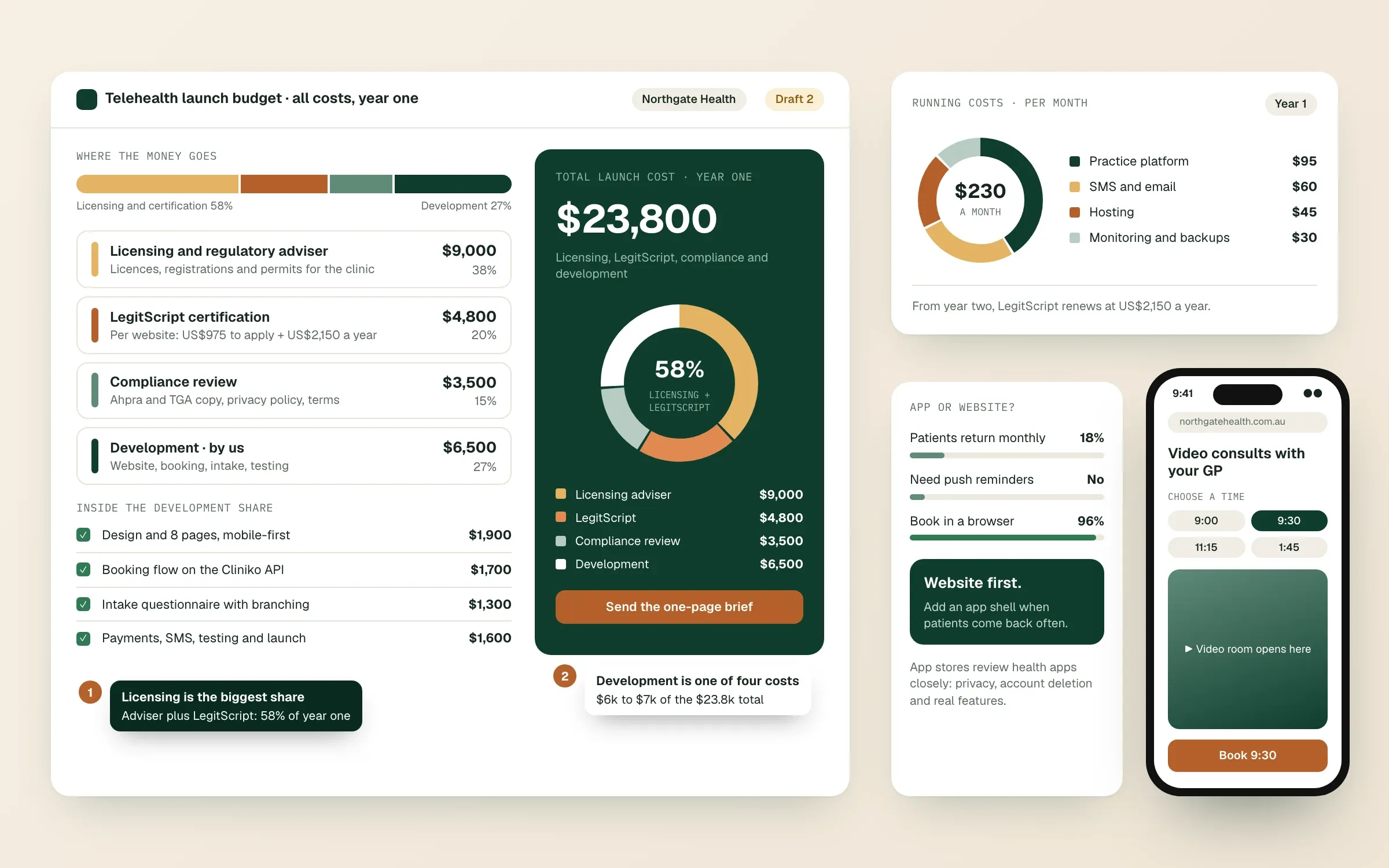
"How much will it cost?" is the first question every telehealth founder asks us, and the honest answer is that it depends less on how many pages you want and more on how your patients will book, be screened and be seen. This read gives rough ranges, explains what moves them, settles the website-versus-app question, and lists the running costs that surprise people. Every figure is a rough guide, not a quote.
What drives the cost
- How patients book. An embedded booking page from your platform is cheap. A fully branded booking flow built on the platform's API is a real software project.
- The intake questionnaire. Branching logic, eligibility rules, clinical review, testing and privacy add up.
- Integrations. Payments, video, prescribing, Medicare claiming and messaging, and how tightly they connect.
- A patient area. Logins, appointment history, documents and repeat requests.
- Compliance work. Ahpra and TGA-safe content structures, consent and tracking set-up, legal page consistency, LegitScript readiness.
- Service lines. Each extra pathway (weight, skin, cannabis, peptides) adds pages, questionnaire logic and testing.
Rough ranges
Our general website guide puts custom business sites at roughly $10,000 to $30,000 and custom web apps or portals from $30,000 upwards. Telehealth sits across those bands:
| Level | What you get | Where it typically sits |
|---|---|---|
| Website plus platform embed | Service pages, legal pages, consent set-up, embedded booking from Halaxy or Cliniko | Custom business site range |
| Website plus custom booking and intake | Branded questionnaire and booking on the platform's API, payments, messaging | Upper custom site range into web app range |
| Full patient platform | Patient area, repeats, documents, multiple service pathways, deep integrations | Custom web app range and above |
These are rough guides. A one-page brief describing what patients should be able to do is the fastest way to a real number.
Do you need an app?
Usually not at the start. A well-built mobile website handles booking, intake and video consults in the browser, and the practice platforms we use run video in the browser too. An app earns its place when patients come back often (repeat care, ongoing programs), when you want push notifications and secure logins on the phone, or when the patient area is central to the service.
There's a middle route we use often: a native app shell around the patient area of your website, with native features such as notifications. It's faster and cheaper than building everything twice, and it's how several of our telehealth clients have reached the App Store and Google Play. Our general mobile app guide puts a focused first version from around $30,000.
App stores also review health apps carefully: expect questions about how medical services are provided, privacy, account deletion and what the app actually does beyond the website.
The compliance work most quotes leave out
When two quotes look very different, this is usually why:
- Questionnaire logic with exclude, flag and collect rules, versioned and tested
- Consent management that actually blocks tags, and tracking kept off health forms
- A banned-terms check so medicine names can't creep into copy, images or code
- Legal pages that match the booking flow, prices and platform settings
- LegitScript readiness if you'll advertise on Google
- Testing every branch on real phones with test data
A cheaper quote that skips these isn't cheaper once you fix them later.
Running costs to budget
| Item | Notes |
|---|---|
| Practice platform | Cliniko, for example, is US$45 a month for one practitioner up to US$395 for 26 to 200; Halaxy is free to start with paid add-ons; MediRecords and its API are quoted |
| Video | Included in Cliniko and Halaxy; a Coviu plan for MediRecords |
| Prescribing | Built into MediRecords; a connected app for Cliniko |
| Claiming | In the platform, or Tyro Health fees for Cliniko |
| LegitScript | US$975 to apply and US$2,150 a year per website, if you advertise on Google |
| Hosting, email, SMS, monitoring | Monthly, modest but not zero |
| Care plan | Updates as rules, services and staff change |
Our Halaxy, Cliniko or MediRecords comparison covers platform costs in more detail, and LegitScript for Australian telehealth clinics covers certification.
How to keep the cost down
- Start with one or two services and add pathways later
- Use the platform's embed first if budget is tight, then go custom
- Make clinical and legal decisions before the build starts
- Have content ready; waiting on copy is the most common cause of overruns
The build order is in how to launch a telehealth clinic website.
Want a real number? Start a brief on Connect.
Finished this read?
- OpenedToday
- FinishedNot yet
Written by
Kevin MatthewsHead of Development
Kevin leads engineering at SingletonTec and has spent 10+ years building production-grade websites, apps and systems for businesses.