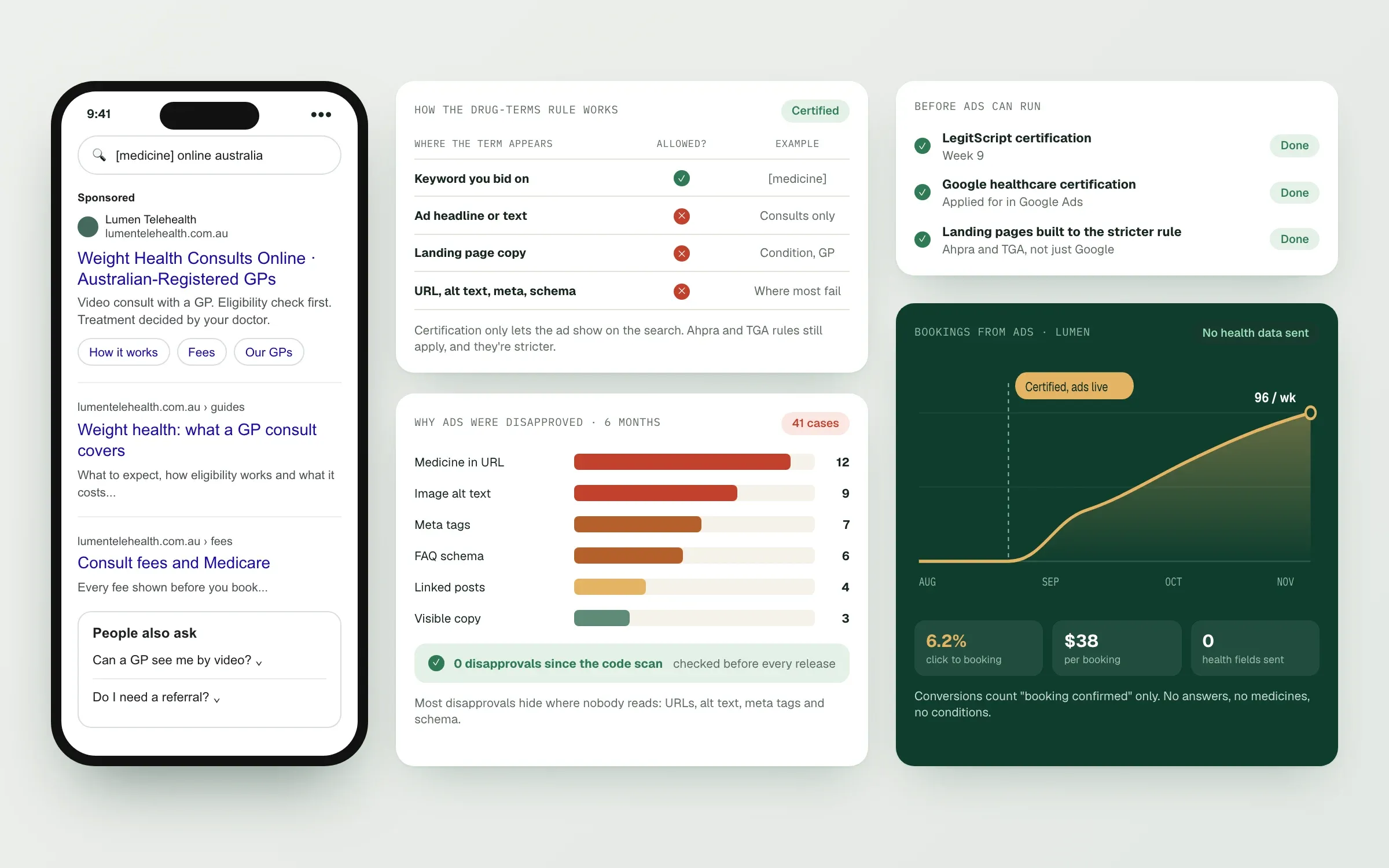
Google Ads can bring a telehealth clinic patients faster than almost any other channel, but only once you clear three gates: LegitScript certification, Google's own healthcare certification, and a review of every ad and landing page for prescription drug terms. Behind those sit Australian advertising rules from Ahpra and the TGA, which are stricter than Google's. We build and fix the landing pages clinics send ad traffic to, so this read covers what Google requires, how the drug-terms rule actually works, and what a landing page that passes review and still converts looks like.
What does Google require before a telehealth clinic can advertise?
Google only allows telemedicine providers to advertise in Australia if they are certified by LegitScript, and then the advertiser must also be certified with Google. The order matters:
- Get the website ready. LegitScript reviews the site, so fix it first.
- Apply to LegitScript. Our pillar read on LegitScript certification for Australian telehealth websites covers costs, timing and where clinics get stuck.
- Apply for Google's healthcare certification in your Google Ads account once LegitScript approves you.
- Launch campaigns with landing pages already built to the rules below.
If you skip step 3, ads stay disapproved even with LegitScript in hand. If you skip step 1, both reviews take longer.
How does the drug-terms rule work?
Since Google's October 2025 update, campaigns targeting Australia cannot use prescription drug terms for promotional purposes in ads or landing pages. Non-promotional mentions, such as legal notices or public health warnings, are allowed. Certified telemedicine providers can still keyword-target prescription drug terms, meaning your ad can show when someone searches a medicine name, as long as the ad and page themselves do not promote it.
In practice, that means a search for a medicine name can trigger an ad that offers a consultation, but the ad and page must talk about the consultation, the condition being assessed and the practitioner, never the medicine.
| Element | Allowed | Not allowed |
|---|---|---|
| Keyword | A prescription medicine name, if you are certified | Nothing extra; certification is what allows this |
| Headline | "Talk to an Australian doctor online about weight management" | Any medicine name, ingredient or brand |
| Description | "Consultations with Ahpra-registered practitioners. Treatment only if clinically appropriate." | "Get your script today", outcome promises |
| Landing page URL | /weight-management-consultation | /buy-[medicine-name] |
| Images | Practitioner, clinic, person using a laptop | Vials, pens, packaging, pills |
What does a landing page that passes review look like?
A telehealth landing page sells the consultation. We build one page per service, matched to one ad group, with the same structure every time:
- Headline about the consultation, using the condition or goal the patient searched for, not a medicine.
- Who you will see: Ahpra-registered practitioners, named where possible, with their profession.
- How it works: book, answer a short health questionnaire, have a real-time video or phone consultation, and, only if clinically appropriate, receive a prescription.
- Eligibility in plain words: who the service is and is not for, and that telehealth is not suitable for everyone.
- Price: the consultation fee, identical to the booking flow, with any Medicare position stated clearly.
- Safety notices: "Treatment is not guaranteed", an emergency line (000), and crisis lines on mental health, weight and sleep pages.
- One clear call to action: book a consultation.
What we leave out is just as important: testimonials and star ratings (restricted by Ahpra), before-and-after photos, superiority claims such as "Australia's best", countdown timers and "limited spots" wording, and any line suggesting a questionnaire alone leads to a prescription.
Where do landing pages fail review?
Almost never in the headline. When certified clinics bring us disapproved ads, the medicine name is usually hiding somewhere nobody reads:
- URLs and slugs, often left over from an earlier version of the site
- Image file names and alt text, especially stock images named after a product
- Meta titles and descriptions, written by an SEO plugin or a previous agency
- FAQ accordions and FAQ schema, which Google reads even when collapsed
- Blog posts linked from the landing page, which reviewers can follow
- Third-party widgets, such as a booking iframe whose service names include a medicine
Our telehealth website launch checklist lists where we look and how we clean each one out.
How do you track conversions without leaking health data?
Ads need conversion tracking, but a health landing page is also where tracking carries the most privacy risk: a page view on a weight or sexual health page can itself reveal health information to an ad platform. We set tracking up so it measures bookings without sending health details anywhere:
- Consent first: ad and analytics tags load only after the visitor agrees, and decline is the default.
- No tags on the questionnaire or booking steps, beyond what is strictly needed to count a completed booking.
- Conversion events carry a booking count and value only, never the service name, answers or condition.
- Session recording tools are kept off every health form.
Our read on tracking pixels and cookie consent on health websites covers the setup in detail.
How do you write ad copy that works within the rules?
Lead with access, speed of booking and the practitioner, because those are the things you are allowed to promote and the things patients care about. Ahpra's guidelines rule out testimonials, unreasonable expectations of outcome and offers without stated terms, so ad copy that works tends to look like this:
- "Online doctor consultations for [condition]. Book a video or phone appointment today."
- "Speak with an Ahpra-registered practitioner from home. Treatment only if clinically appropriate."
- "Transparent consultation fees. See availability and book online."
Avoid "fast results", "guaranteed", "no consult needed", "cheapest" and anything that sounds like a product listing.
The pre-launch ad checklist
// checklist0 of 8 done
Sources
All checked 21 Nov 2026.
Finished this read?
- OpenedToday
- FinishedNot yet
Written by
Kevin MatthewsHead of Development
Kevin leads engineering at SingletonTec and has spent 10+ years building production-grade websites, apps and systems for businesses.