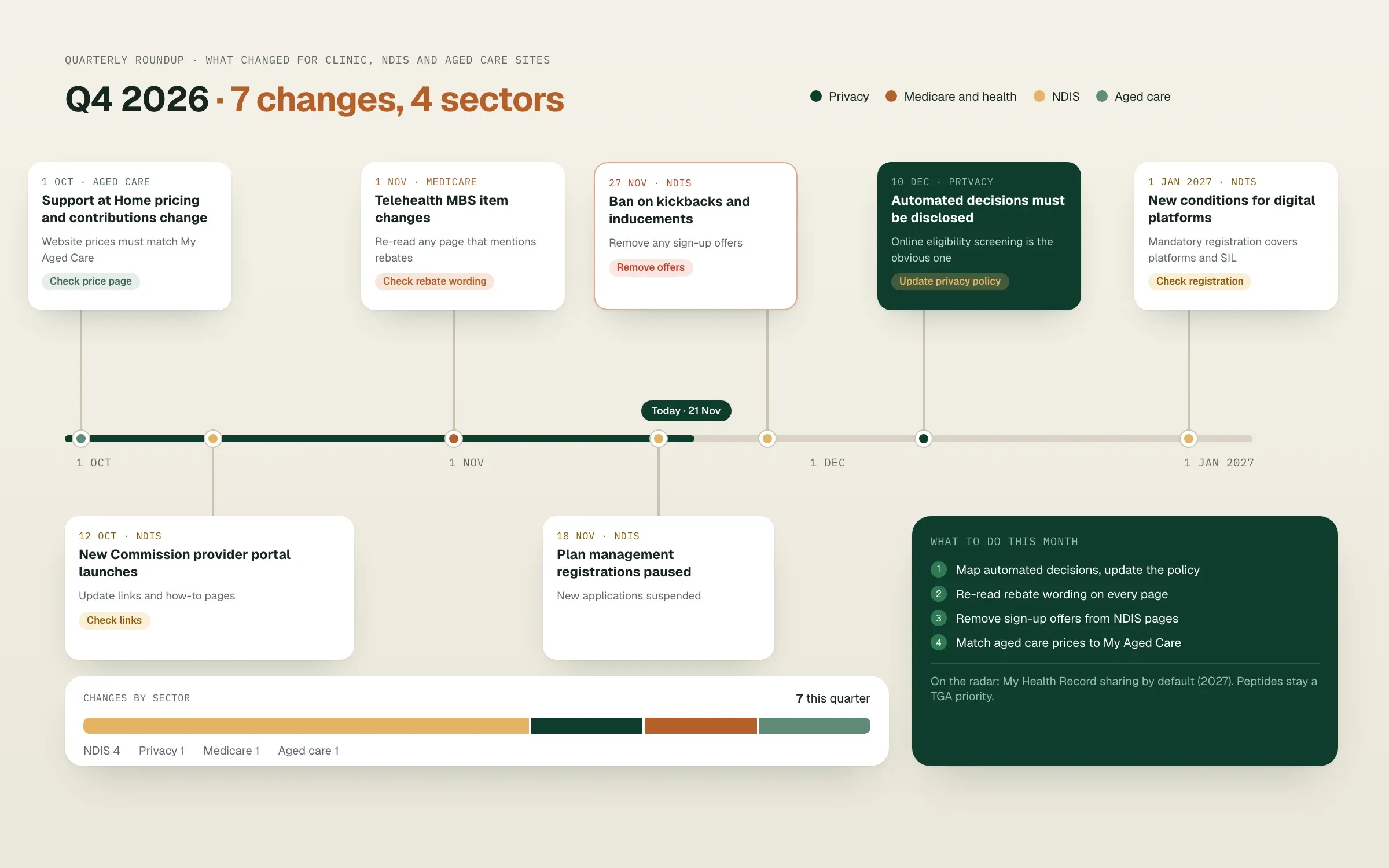
The last quarter of 2026 was busy. None of the changes below is about websites as such, but almost all of them end up on one: in a privacy policy, a pricing page, a booking flow or a sign-up offer. This roundup is written from where we sit, building sites and platforms for clinics, NDIS providers and aged care services. For each change you get what happened, then what we would check or change on your site. It is current as of late November 2026, so anything after that date is not covered.
Privacy: automated decisions must be disclosed from 10 December
This is the one with a hard deadline. From 10 December 2026, any organisation covered by the Privacy Act that uses a computer program to make, or substantially and directly help make, decisions that significantly affect people must say so in its privacy policy. The OAIC published its final guidance at the end of September.
For a telehealth clinic, an eligibility questionnaire that blocks some people from booking is the clearest example. For NDIS and aged care providers, think about automated intake triage, waitlist ordering or automated account restrictions.
What we'd check: list every rule in your platform that can refuse, delay or prioritise someone, send that list to your privacy adviser, and get the policy updated before the 10th. We wrote a full read on this: automated eligibility screening and the December 2026 privacy rules.
Medicare: telehealth item changes from 1 November
The November MBS update made six inpatient telehealth psychiatry items permanent and changed how often they can be claimed, alongside other telehealth determinations, including one covering chronic condition management phone services.
Most clinic websites will not mention these items by number, and they shouldn't. But many GP telehealth sites still carry rebate wording written two or three years ago.
What we'd check: search your site, FAQs and booking confirmation emails for "rebate", "bulk billed" and "Medicare". Make sure nothing promises a rebate, and that the billing model is described the same way everywhere. Item eligibility is a question for your practice manager, not your website copy.
My Health Record: online prescribers sharing by default, targeted for 2027
This one is not law yet, but it is coming. Earlier this year the Federal Government consulted on making online prescribing services share prescribed and dispensed medicine information to My Health Record by default, with a 2027 target, whether or not Medicare funding is involved.
What we'd do now: if you are choosing or replacing a practice platform, ask how it handles My Health Record today. Platforms with built-in My Health Record connections will make this far easier than custom integrations bolted on later. We cover the build side in our read on My Health Record integration for telehealth platforms.
TGA: peptides stay a compliance priority
The TGA formally named unapproved peptides as a compliance focus for 2026 and, mid-year, put promoters and suppliers on notice that enforcement was stepping up, including against influencers and affiliates. Nothing in Q4 suggests that has eased.
What we'd check: on any peptide, longevity or weight management site, search the copy, alt text, URLs, meta tags and schema for product names, ingredient names and nicknames. The visible copy is usually fine by now; the leftovers in the code are what get clinics into trouble.
NDIS: new portal, more mandatory registration, and no more inducements
Three changes landed for NDIS providers this quarter:
- New NDIS Commission portal. The Commission's new provider portal launched on 12 October 2026.
- Mandatory registration expands. Providers of Supported Independent Living and NDIS digital platforms now have to be registered. Unregistered providers had until 1 October 2026 to apply, and new conditions for digital platforms apply from 1 January 2027.
- Plan management registrations paused. The Commission suspended new registration applications for plan management services from 18 November 2026 while new arrangements are developed.
The government's reform timeline also lists a ban on providers offering kickbacks and inducements, starting 27 November.
What we'd check: look for any "sign up and get" offer on your site, landing pages or social posts: gift cards, free sessions for switching, referral rewards. Those are exactly what an inducement ban targets. Also make sure your registration status and registration groups are shown accurately, especially if you run a platform or SIL. Our read on NDIS provider websites covers the rest.
Aged care: Support at Home pricing and new consumer protections
Support at Home funding changed from 1 October 2026, including how personal care contributions work. The government also paused the planned price caps and announced extra consumer protections instead. Providers must keep prices reasonable, publish the price they most often charge for each service on My Aged Care, and the Aged Care Quality and Safety Commission can order refunds where providers overcharge.
What we'd check: if your website shows prices, make sure they match what you publish on My Aged Care. Two different numbers for the same service is the kind of mismatch that turns into a complaint. Price change notices on your site should match what your service agreements say.
What to do this month
If you only have an afternoon before the holidays, do these in order:
- Update your privacy policy for automated decisions, if your platform screens or ranks people.
- Search your site for rebate and Medicare wording and make it consistent.
- NDIS providers: remove any sign-up incentives and check registration details.
- Aged care providers: line up website prices with My Aged Care.
- Peptide and weight management clinics: search the code, not just the copy, for product names.
Sources
All checked 21 Nov 2026.
- APP 1.7 to 1.9 transparency obligation fact sheet (PDF), OAIC
- November 2026 news, MBS Online
- Changes to registration for plan management services, NDIS Commission
- Securing the NDIS for future generations timeline (PDF), Department of Health, Disability and Ageing
- New consumer protections for Support at Home services, Department of Health, Disability and Ageing
Finished this read?
- OpenedToday
- FinishedNot yet
Written by
Kevin MatthewsHead of Development
Kevin leads engineering at SingletonTec and has spent 10+ years building production-grade websites, apps and systems for businesses.