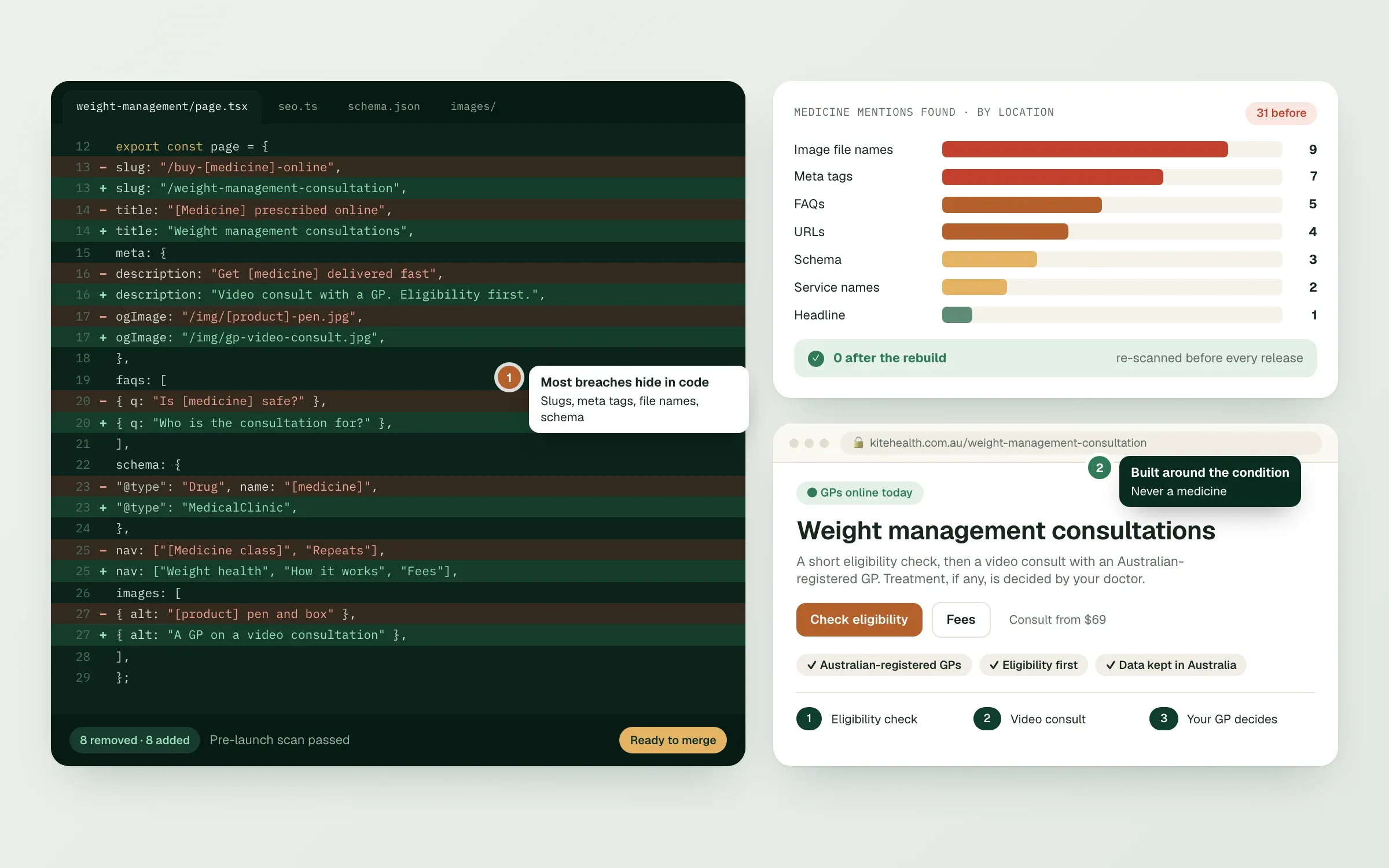
The rule itself is short. Prescription-only medicines can't be advertised to the public in Australia, apart from a few narrow exceptions. What makes it hard is that a clinic website is full of places where a medicine can slip in without anyone deciding to advertise it: a service called after a drug, an FAQ answer that names one, an image file uploaded straight from a supplier. We build and audit telehealth, cosmetic and weight management sites, and this is the read we wish every clinic founder had before the first design meeting.
What does the law actually say?
The Therapeutic Goods Act prohibits advertising prescription medicines to the public, apart from limited circumstances such as advertising directed only at health professionals. The same restrictions cover Schedule 4 (prescription-only) and Schedule 8 (controlled drug) substances, and many Schedule 3 pharmacist-only medicines.
The TGA does not regulate health services. You can advertise a GP consultation, a skin assessment or a weight management program. The catch is in the next sentence of its guidance: if an advertisement for a health service also advertises therapeutic goods, it has to comply with the Act.
That is the line every telehealth and cosmetic site has to build around: the service is the product, the medicine is a clinical decision made in the consultation.
When does a clinic website become an ad for a medicine?
When it names, shows or clearly points to a prescription medicine in a way that promotes its use or supply. That includes:
- Direct references: brand names, generic names, active ingredients.
- Nicknames and shorthand: the names patients and social media use for a medicine.
- Classes used promotionally: "weight loss injections", "GLP-1 program", "peptide therapy", "plant medicine" as the thing you are selling.
- Pictures: pens, vials, syringes, pill packs, cannabis flower.
- Context: a page titled "Get [medicine] online" is advertising even if the medicine is never named in the body.
The last two catch people out most. A clinic can scrub every medicine name from its copy and still have a hero image of an injection pen and a URL ending in the medicine's name.
Where do clinic builds go wrong?
These are the places we find medicine references on clinic sites, roughly in order of how often we see them.
| Where | What we find | What we change it to |
|---|---|---|
| Service names and navigation | A service named after a medicine or medicine class | The condition or goal: "Weight management consultation" |
| URLs and slugs | /buy-[medicine], /[medicine]-online | /weight-management-consultation |
| FAQs | "Is [medicine] safe?" with a promotional answer | General questions about the consultation and eligibility |
| Images | Product shots, injection pens, vials, file names with product names | Practitioner, clinic, patient-at-home imagery with neutral file names and alt text |
| Meta titles, descriptions and schema | Product names written by an SEO plugin or previous agency | Service-led titles and Service or MedicalClinic schema |
| Pricing tables | "[Medicine] plan: $X a month" | Consultation and program fees, with medicines described as "if clinically appropriate" |
| Blog posts | Comparisons of medicines, "how [medicine] works" | Condition education that does not steer to a product |
| Third-party widgets | Booking or payment items named after medicines | Rename the items in the platform's admin |
| Emails and SMS | Booking confirmations naming the medicine | Consultation-only wording before any prescription |
The code-level checks are covered in our telehealth website launch checklist.
Is any mention of medication allowed?
A neutral, non-promotional mention is generally treated differently from advertising. Most clinics need to tell patients, somewhere, that a practitioner may prescribe. The pattern we use is a short statement in "How it works", the FAQs and the Terms:
No names, no benefits, no pricing tied to a product. The clinic is honest about what it does without promoting a medicine. Hiding the model altogether creates a different problem: a site that never says it prescribes can mislead patients about what they are paying for.
Peptides, medical cannabis and weight loss: why they get extra attention
Three service lines draw most of the TGA's attention right now, and each has its own read:
- Peptides. The TGA made unapproved peptides a compliance priority for 2026 and warned that influencers and affiliates promoting them can be held accountable too. See peptide clinic websites in 2026.
- Medical cannabis. The TGA says a health service advertisement that refers to medicinal cannabis would likely have the effect of advertising medicinal cannabis. Condition lists next to a cannabis clinic brand are a common problem. See medical cannabis clinic websites.
- Weight loss. The TGA has publicly reminded businesses that advertising prescription-only weight loss medicines is unlawful. See weight loss program websites.
What happens if a clinic gets it wrong?
The TGA usually starts with education and warning letters, but its toolkit runs to infringement notices, civil penalty proceedings and, in serious cases, criminal prosecution. Enforcement against peptide businesses in particular has been stepping up through 2026.
There is a practical cost too. A site the TGA would see as advertising a medicine is also a site Google will disapprove ads for, and one LegitScript will question. Getting this right once fixes all three.
How do we build TGA-safe clinic sites?
We don't rely on someone remembering the rules at 6pm before launch. We build them into the structure:
- Services are consultations. The CMS content model has fields for the condition, the consultation, eligibility, practitioner type and fee. There is no field for a medicine name, so nobody fills one in.
- Slugs are generated from service names, not typed by hand, so a medicine name cannot creep into a URL.
- A banned-terms check runs before publishing. We keep a list of medicine names, ingredients and nicknames relevant to the clinic's services and scan copy, alt text, file names, meta tags and schema for them. Anything flagged needs a human decision.
- Images are chosen for the service, not the product, and renamed on upload.
- Third-party tools are configured too. Booking and payment item names often appear in emails and receipts, so we set those up alongside the site.
- Clinical content is reviewed. Health information pages go to the clinic's clinical lead before they go live.
If you want this done for your clinic, see how we build healthcare websites and platforms.
Sources
All checked 21 Nov 2026.
Finished this read?
- OpenedToday
- FinishedNot yet
Written by
Kevin MatthewsHead of Development
Kevin leads engineering at SingletonTec and has spent 10+ years building production-grade websites, apps and systems for businesses.