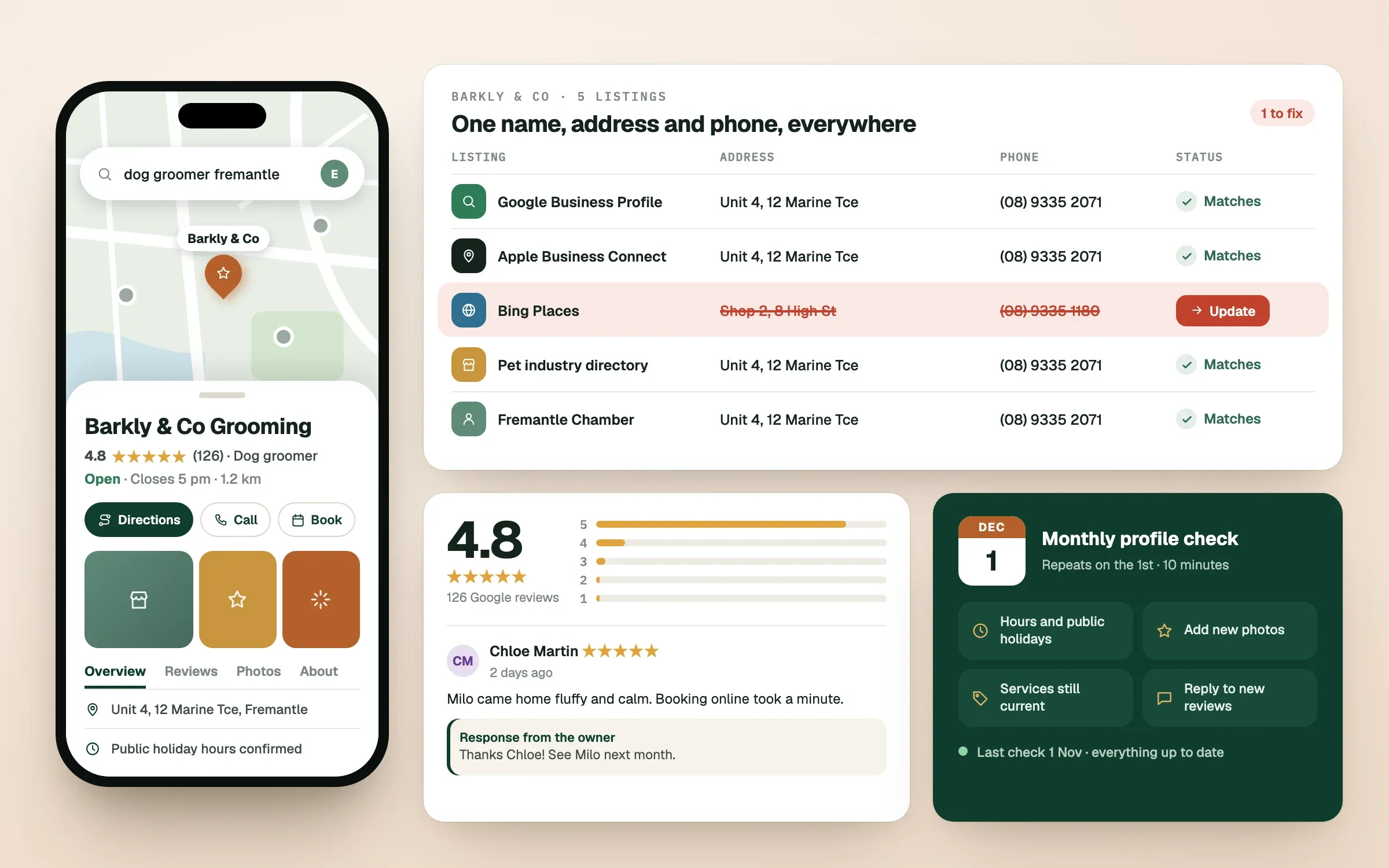
Local SEO Australia comes down to one idea: when someone nearby searches for what you do, Google decides whether to show you, and your job is to give it good reasons. It is how a plumber appears for "plumber near me", a café for "best coffee in Fremantle" and a physio for "physio open Saturday". The good news is that most of it is within a small business's control.
What is local SEO, and how is it different from normal SEO?
Local SEO is the part of search engine optimisation focused on customers in a specific place. Normal SEO tries to rank a page for a topic anywhere. Local SEO tries to show your business to people close to you, usually in the map results with three businesses listed, often called the "map pack", and in the regular results below.
Google says local results mostly depend on three things: relevance (does your business match what was searched), distance (how close are you to the person or the place they named) and prominence (how well known and trusted you appear). You cannot move your shop. You can improve the other two.
What should you fix first? Your Google Business Profile
Your Google Business Profile is the free listing that appears on Google Search and Maps, and it is the best starting point. Claim it, verify it, and then complete every section honestly.
The details that matter
- Use your real, legal trading name. Adding keywords to the name breaks Google's rules and can get the listing suspended.
- Choose the most accurate main category, then add secondary ones that genuinely apply.
- Keep your hours, including public holidays, up to date.
- Add each service with a short plain description.
- Add real photos of your premises, team and work, and keep adding them.
- If you travel to customers, set the areas you serve and hide your home address if you work from home.
Why do reviews matter so much?
Reviews are the strongest public signal of trust, both for Google and for the person deciding between you and a competitor. A steady flow of recent, genuine reviews does more than a burst of them once a year.
Ask every happy customer, at the moment they are happy, with a direct link to your review page. Reply to every review, including the poor ones, calmly and without arguing. Do not buy reviews, write your own or offer rewards for positive ones. Fake or misleading reviews are against Google's rules and can also breach Australian consumer law, so the risk is not worth it.
Do you need a page for every suburb?
No, and building dozens of near-identical suburb pages usually backfires. Google calls this approach doorway pages and treats it as low quality. Instead, build a page only where you have something real to say.
A good local page covers one service or one genuine service area, uses the way locals actually describe the area, shows real examples and photos, lists clear prices or how pricing works, and answers the questions that area's customers ask. If you only have one shop, one strong page per main service plus an easy-to-find contact page often beats thirty thin ones.
Your website itself still matters. It needs to be fast on a phone, show your address and phone number as plain text, and carry local business structured data, a short hidden label that tells search engines what your business is and where. Our lead engineers add this as standard on every build.
Where else should your business be listed?
Listings in other directories act like a second opinion that your details are real. Consistency matters more than quantity: the same name, address and phone number everywhere.
Table: Common places to check for an Australian local business
| Place | Why it helps |
|---|---|
| Google Business Profile | Appears in Search and Maps, the most important one |
| Apple Business Connect | Feeds Apple Maps and Siri on iPhones |
| Bing Places | Feeds Bing search and some voice assistants |
| Industry directories | Trusted by customers and relevant to your trade |
| Local chamber of commerce or association sites | Real local mentions and links |
| Social profiles | Often show up in branded searches |
Directory names and features change, so check which ones are active for your industry before paying for any listing.
How do you know it is working?
Track the things that turn into customers. In Google Business Profile, you can see how many people called, asked for directions or visited your website from your listing. In Google Search Console, you can see which searches show your site. In Google Analytics, you can see which visits become enquiries.
Local SEO tends to build over months rather than days, and results vary by how competitive your suburb and trade are. Each month we send our Grow clients a plain-language report and share access to Analytics and Search Console, so you can see calls, clicks and enquiries side by side instead of guessing.
Finished this read?
- OpenedToday
- FinishedNot yet
Written by
Samia AkramHead of Marketing

Samia heads marketing at SingletonTec and runs the work that brings customers in: local SEO, Google and Meta ads, and a brand that gives people a reason to choose you.