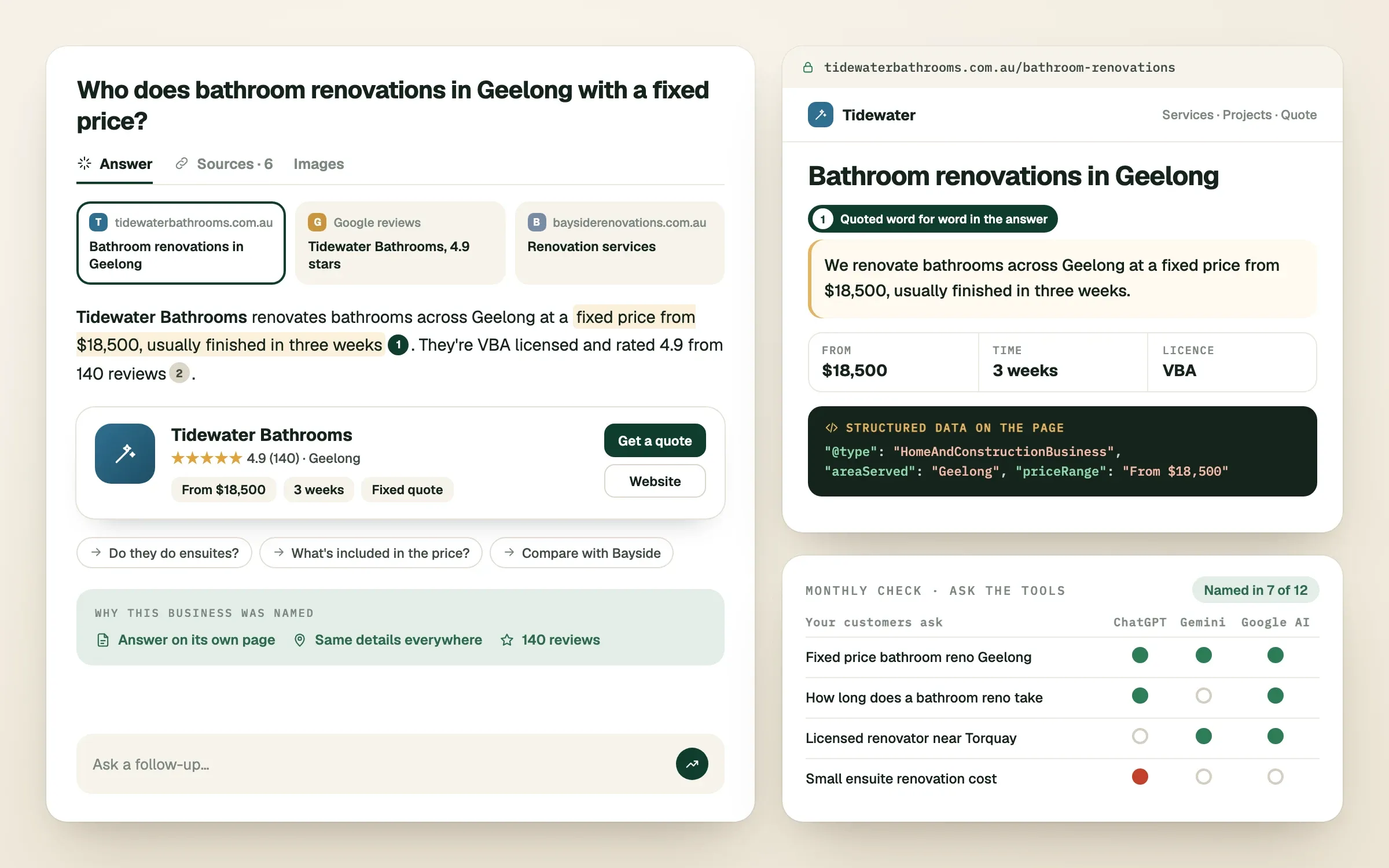
Showing up in AI search means your business gets named, quoted or linked when someone asks ChatGPT, Gemini or Google's AI Overviews a question. People call the practice generative engine optimisation, or GEO. Here is the honest summary from the engineers who build these sites: GEO is mostly good SEO with clearer writing, and nobody can promise you a mention.
What is generative engine optimisation (GEO)?
Generative engine optimisation is the work of making your website easy for AI tools to find, understand and trust, so they are more likely to use it when they write an answer. Classic SEO (search engine optimisation) aims to put your page in a list of links. GEO aims to put your information inside the answer itself.
The two overlap heavily. The same page that is fast, clear and well organised helps both. The difference is the reader: a search engine ranks pages, while an AI tool reads them, pulls out the useful parts and rewrites them in its own words.
Table: Classic search compared with AI answers
| Classic search results | AI answers | |
|---|---|---|
| What the person sees | A list of links | A written answer, sometimes with sources |
| What gets rewarded | Relevant, trusted pages | Clear, direct, trusted passages |
| How you win | Rank high on the list | Be one of the sources the answer draws on |
| Typical click | Straight to your site | Often fewer clicks for some searches |
How do AI tools decide which businesses to mention?
They lean on pages they can read, sources that look trustworthy, and facts that agree across the web. We cannot see inside these systems, and they change often, so treat the following as tendencies, not rules.
First, the tool has to be able to reach and read your page. If key content hides inside images, pop-ups or scripts that fail to load, it may as well not exist.
Second, the page has to answer the question in a way that is easy to lift out. A clear definition or a direct answer in the first lines of a section is far easier to quote than a vague introduction.
Third, the facts have to match. If your phone number, services and opening hours differ between your website, Google Business Profile and directories, the tool has less reason to trust any of them.
What can you change this month?
Six changes cover most of what is within your control. None needs a rebuild.
1. Answer the question first
Open each page and each section with the direct answer in one or two plain sentences, then explain. If a page is about "how much does a dental implant cost", the first lines should say what the price depends on and give a typical range. Questions used as headings help too, because they match how people phrase things to an AI tool.
2. Keep the important facts in plain text
Prices, opening hours, service areas and how-it-works steps should be real text on the page, not baked into a picture or a PDF. Text can be read, quoted and checked.
3. Make your business details identical everywhere
Use the same business name, address, phone number and service descriptions on your website, Google Business Profile and any directory listings. Small differences, such as "St" in one place and "Street" in another, are minor, but different services or phone numbers are a real problem.
4. Let the right crawlers in
Crawlers are the automated programs that read websites. A file called robots.txt tells them what they may visit. Check that it does not block your whole site by accident, which happens more often than you would think after a redesign. Whether to allow particular AI crawlers is a business choice, and we are happy to talk it through.
5. Add structured data
Structured data is a short, hidden label in your page code that tells machines what the page is: a business, a service, a list of questions and answers. It does not guarantee anything, but it removes guesswork. Our lead engineers add it as a normal part of every build.
6. Be mentioned by others
AI tools weigh what the wider web says about you. Genuine reviews, local directory listings, industry association pages and a mention in a local news or supplier page all count as evidence that you are real and relevant.
What should you avoid?
Avoid shortcuts, because they tend to backfire. Do not mass-produce thin pages with AI writing and hope for the best, since pages that add nothing new give a tool no reason to quote you. Do not stuff pages with keywords, hide text, or buy mentions on dodgy sites. And do not rewrite your whole website around a trend. The sensible order is to fix the basics, then sharpen the answers.
There is also a proposed plain-text file called llms.txt that some people suggest adding to help AI tools. Treat it as optional and unproven for now. It will not replace clear pages.
How do you know if it is working?
Look at three things together. First, your own monthly question check from the tip above. Second, Google Search Console, a free Google tool that shows which searches show your pages and how many people click. Third, Google Analytics, which can show visits that arrive from AI tools as their own source, so you can see whether any real people are coming through.
Do not expect a tidy number. This area is young, the tools report on it unevenly, and clicks may fall even while your brand gets mentioned more. Watch the quality of enquiries as well as the count.
With every Grow project we give you access to Google Analytics and Search Console from day one and send a plain-language report at the end of each month, so you can see what is changing without needing to decode it.
A short checklist to start
// checklist0 of 6 done
Finished this read?
- OpenedToday
- FinishedNot yet
Written by
Samia AkramHead of Marketing

Samia heads marketing at SingletonTec and runs the work that brings customers in: local SEO, Google and Meta ads, and a brand that gives people a reason to choose you.