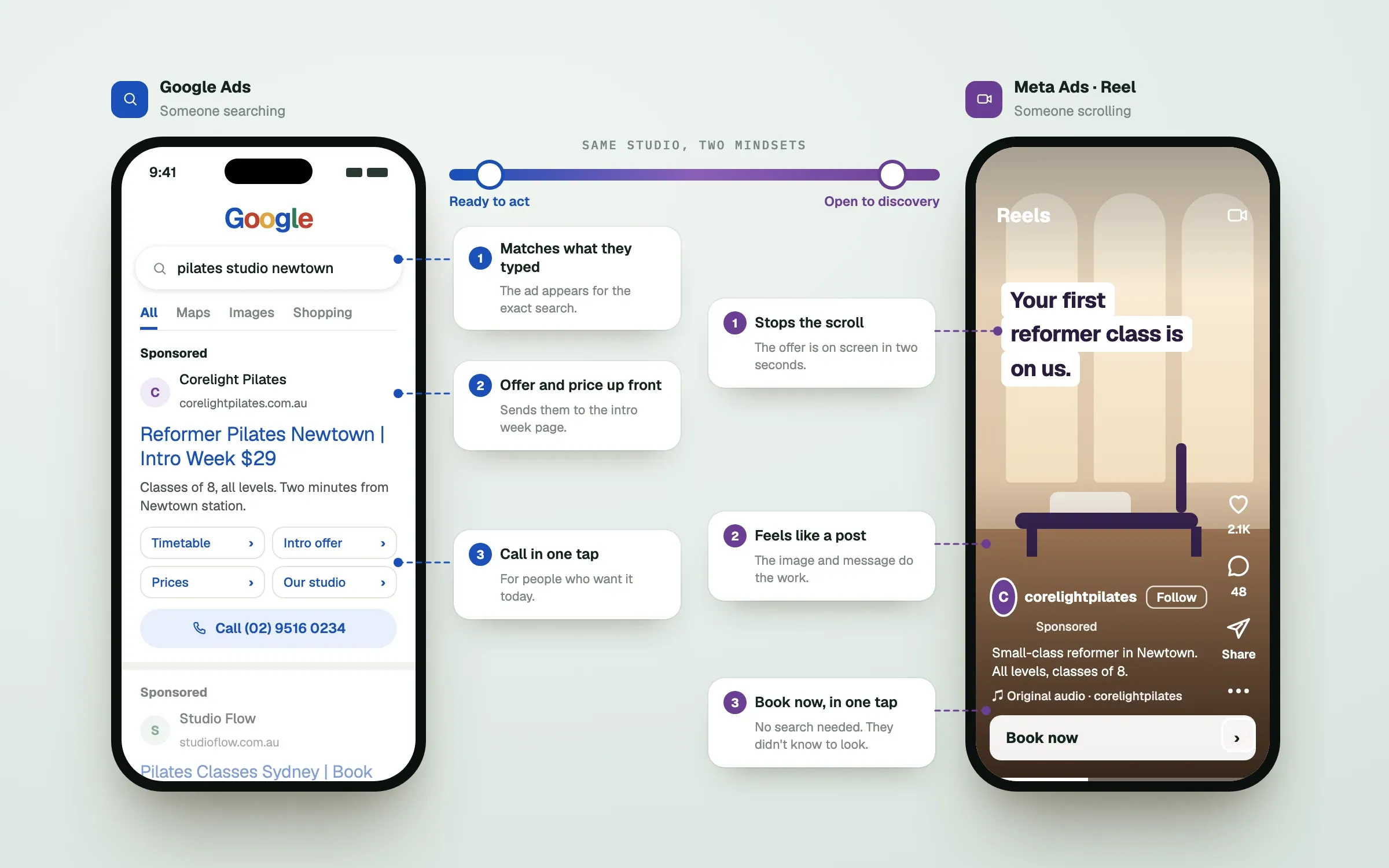
Google Ads or Meta Ads? The short answer: start with Google Ads if customers already search for what you sell, and start with Meta Ads (Facebook and Instagram) if people need to be introduced to what you offer. Both work. The mistake is choosing by habit or by what a competitor does, rather than by how your customers actually buy.
What is the real difference between the two?
The difference is intent. With Google Ads, someone types a question or a need into Google and your ad appears alongside the results. They already want something. With Meta Ads, your ad appears in the feed of someone scrolling Facebook or Instagram because they match an audience you chose, such as age, location and interests. They were not looking for you, so the ad has to earn attention.
Think of it as a shopfront versus a street stall. Google puts your sign where customers are already walking in looking. Meta puts your stall where customers are strolling and gets them to stop.
Table: Google Ads and Meta Ads side by side
| Google Ads | Meta Ads (Facebook and Instagram) | |
|---|---|---|
| Where it appears | Search results, Maps, YouTube and partner sites | Facebook, Instagram and partner apps |
| Who sees it | People searching for something | People in a chosen audience, scrolling |
| Customer mindset | Ready to act | Open to discovery |
| What matters most | Keywords, ad copy, your landing page | Image or video, message, audience |
| Typically suits | Urgent or specific needs, local services | New, visual or impulse products, awareness |
| Speed to first leads | Often days | Often days, but needs more testing |
| Main risk | Paying for clicks that never convert | Getting views and likes without sales |
Which one should you start with?
Pick by how your customers find you today. Ask yourself: if someone had your problem tomorrow, would they type it into Google?
Start with Google Ads if
- People search for your service by name, such as "emergency plumber", "dentist near me" or "wedding photographer Perth"
- Your customers need something soon and decide quickly
- You have a clear service or product page to send them to
Start with Meta Ads if
- Your product is new, visual or something people do not know to search for
- You want to build awareness in a local area, or reach a specific group
- You sell something where seeing the product, a before and after, or a short video helps
Use both when
Your budget allows it and you have the tracking in place. A common pairing is Google to capture the people ready to buy and Meta to remind and reach those who are not yet searching.
What does it cost, and how should you budget?
Both platforms let you set a daily or monthly limit, so you stay in control. How much a click or enquiry costs depends on your industry, your location and how strong your ads and page are. We will not quote a figure here, because honest numbers depend on your market.
A sensible way to start is to set a modest test budget for four to six weeks, with a limit you are comfortable losing if it does not work, and agree upfront what a good result looks like, such as the number of enquiries or the cost per enquiry. Increase spending only after the numbers prove it pays for itself.
Remember that the ad platform's charge is not the whole cost. Allow for design, a landing page, and someone to manage and improve the campaigns.
What must be in place before you spend anything?
Ads send visitors to your website. If the website cannot turn them into enquiries, you pay for the traffic and get nothing back.
Before switching ads on, check:
- There is a page built for the ad, with one clear action, such as call, book or request a quote
- The page loads quickly on a phone
- Tracking is installed, so you know which ad produced which enquiry
- Phone calls and form submissions are counted as results
- Someone replies to enquiries quickly
Who should run the ads?
You can run a small campaign yourself, and plenty of owners do. The trade-off is time and the learning curve, since both platforms have many settings that can quietly waste money. If you hire help, ask who actually does the work, whether you own the ad accounts, whether you get direct reports, and whether the same people also look after your website. When ads, website and reporting sit with one team, problems are found faster, which is why we offer Build, Brand and Grow under one roof.
Finished this read?
- OpenedToday
- FinishedNot yet
Written by
Samia AkramHead of Marketing

Samia heads marketing at SingletonTec and runs the work that brings customers in: local SEO, Google and Meta ads, and a brand that gives people a reason to choose you.