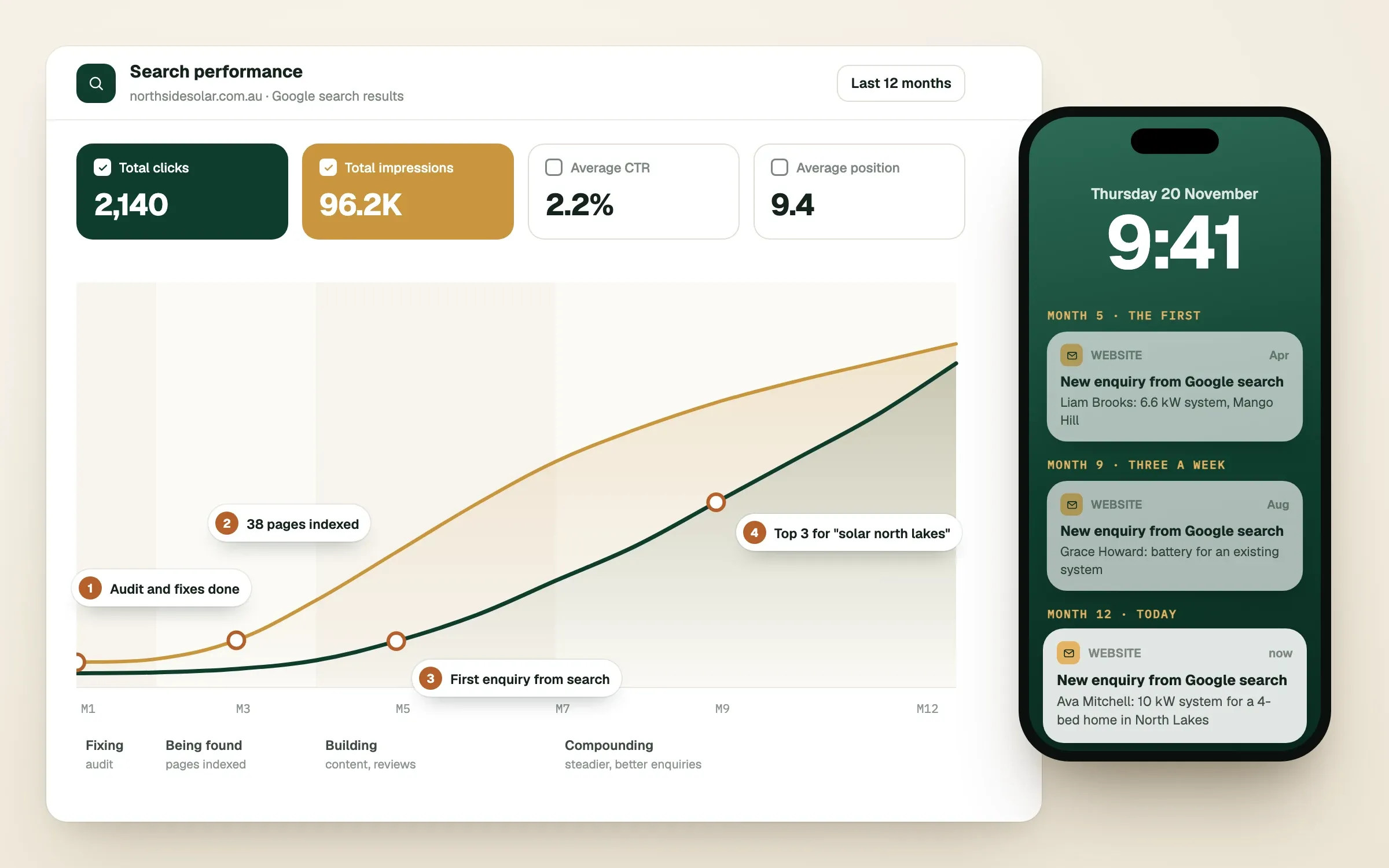
So, how long does SEO take? For most small businesses, it takes several months to see steady results, and longer in competitive industries. We cannot give you an exact date, and we would be wary of any agency that does. Here is what actually decides the timeline, what you can reasonably expect along the way, and how to tell an honest estimate from a sales line.
Why is there no fixed answer?
SEO, or search engine optimisation, is the work of earning a place in Google's unpaid results. Nobody controls how and when Google ranks pages, and the field you compete in changes the speed. A new local business in a quiet suburb is racing against a few rivals. A national online store is competing with thousands.
That is why a reliable estimate only comes after someone has looked at your actual situation. A quote that names a specific ranking by a specific date without looking at your site is a warning sign.
What decides how long it takes?
Five things do most of the work.
1. How competitive your searches are
Rare, specific searches such as "emergency plumber in Joondalup" are easier to win than broad ones such as "plumber". The more businesses with strong sites chasing the same phrase, the longer it takes.
2. The age and health of your website
A new site has no track record, so it starts from a low base. An older site with technical problems may need repairs before it can climb. A healthy site with real history moves faster.
3. How much useful content you publish
Pages that genuinely answer customer questions give Google more to show. Publishing steadily over months beats a burst in week one followed by silence.
4. Your authority and reputation
Search engines look at who else vouches for you: reviews, directory listings and links from other trusted sites. These build slowly, which is part of why SEO is slow.
5. Local or national reach
Local searches, such as those that trigger the map results, often move sooner than national ones, because there are fewer rivals within a few kilometres.
What does the timeline usually look like?
Every project differs, so read this as a guide to the shape of progress, not a promise.
Table: A typical pattern for a small business SEO project (a guide only)
| When | What is usually happening | What you might notice |
|---|---|---|
| Month 1 | Audit, fixing technical problems, setting up tracking, planning pages | Not much traffic change yet |
| Months 2 to 3 | New and improved pages are found and indexed, listings and profiles are tidied | More search impressions, first small movements |
| Months 3 to 6 | Content builds, reviews accumulate, pages start to earn positions | Rising clicks, first enquiries from search |
| Months 6 to 12 | Compounding: pages that worked get strengthened, new ones added | More consistent enquiries, better-qualified ones |
What can speed things up, and what slows them down?
You can help the timeline in several ways. Fix the technical basics first. Answer real customer questions on your pages. Claim and complete your Google Business Profile if you serve a local area. Ask satisfied customers for genuine reviews. Make decisions quickly, because delays in approving content are one of the most common reasons projects drift.
Things that slow it down include changing your website's structure or address often, publishing thin or copied content, switching strategy every few weeks, and expecting SEO to perform without a working website to send people to.
How is SEO different from Google Ads?
Ads can send visitors within days of switching on, but they stop when the budget stops. SEO is slower to start but tends to keep working without paying for every click. Neither is better in the abstract. Many small businesses use ads for quick leads while SEO builds, then rebalance as the unpaid results grow.
What are the warning signs of a dishonest promise?
Be careful with anyone who guarantees position one, promises results by a fixed date without looking at your site, hides which pages or keywords they are working on, or will not give you access to your own analytics. Real SEO work is visible and shareable.
Our approach is simple. A lead engineer reviews your site first and gives you a written plan with the work and the engineering hours behind it. You get access to Google Analytics and Search Console from the start, and a plain-language report at the end of each month showing what changed. If something is not moving, you see it and we talk about it.
Finished this read?
- OpenedToday
- FinishedNot yet
Written by
Umair NasirGrowth Analyst

Umair is SingletonTec's growth analyst. Umair reads the numbers behind websites and ad campaigns, finds where visitors drop off, and turns that into the next change worth making.