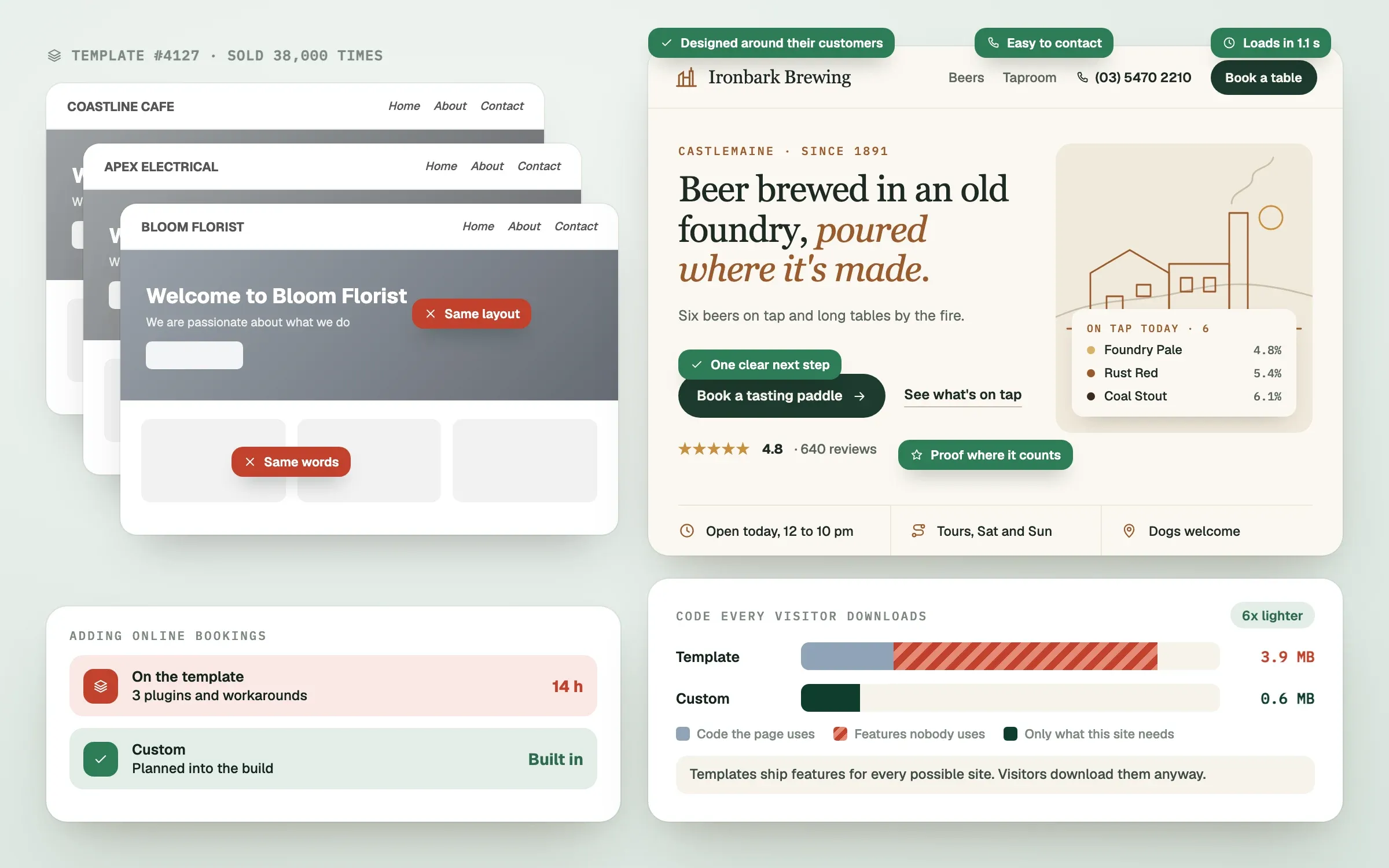
A template website is a ready-made design that you fill with your own words and pictures. A custom website is designed and engineered for one business only. In the custom website vs template debate, we are not neutral: our name comes from a coding idea about building one unique thing, and every site we make is engineered for a single client. This opinion explains why, and when a template is still a fair choice.
What is a template website, exactly?
A template is a finished layout, with colours, sections and styles already decided, that many different businesses can buy and reuse. You swap in your logo and text, and the site goes live.
Website builders and theme marketplaces work this way. The appeal is easy to see: it is fast, familiar and usually the lowest upfront price.
The limits are built in. A template was made for an average business that does not exist. Your business has particular customers, particular questions and a particular way of winning work. A template cannot know any of that.
Why do we never use templates?
We never use templates because we start from your business and your customer's journey, not from a layout that already exists. Starting from a template means working backwards: you bend your business to fit the design.
Three reasons sit behind our choice:
Sameness. Templates are sold to thousands of people. Your site can end up looking like a stranger's, which works against the whole point of having a brand.
Hidden weight. Templates often ship with features for every possible user. You carry code you never use, and that can slow your pages down. Speed matters for visitors and for search.
Fights, not fixes. When you need something the template did not plan for, developers end up working around it. That costs more hours than building the right thing from the start.
When is a template actually fine?
A template can be a sensible choice when your needs are small, short-lived or experimental. We would rather say that plainly than pretend otherwise.
A template may suit you when:
- you are testing an idea and need something online this week
- your budget is very tight and the site's job is simple, such as showing contact details
- the site is temporary, for an event or a short campaign
- you do not yet know what your brand is, and you plan to rebuild once you do
Does custom mean expensive and slow?
Custom does not have to mean enormous, and it is not always slower. It means the effort goes into what your business needs, rather than into undoing what you do not.
Price follows scope, not the word "custom". A small custom site with a few well-built pages can cost less than a large template site loaded with paid add-ons. Our quotes are based on scope, features, the user journey and engineering hours, and the plan is written and approved before any work begins.
Speed is similar. Because you talk directly to the lead engineer building your site, there are no layers of managers passing messages along. Decisions happen in the conversation, and you see staging links as the work moves forward.
How do you decide between a template and a custom website?
Decide by asking what your website must do for your business in the next two years. Choose a template for quick, low-stakes needs. Choose custom when the site is part of how you win customers.
Ask yourself:
- Will customers judge my business by this site?
- Do I need features a template does not offer, such as bookings, portals or integrations?
- Does my brand need to look and feel like only me?
- Will I be paying to patch this in a year?
If you answer yes to most, you are likely better off with a custom build. If you answer no, a template can be a reasonable, honest start.
Whatever you choose, ask who owns the result and what happens when you want to change it. A good partner answers that clearly.
Finished this read?
- OpenedToday
- FinishedNot yet
Written by
Kevin MatthewsHead of Development
Kevin leads engineering at SingletonTec and has spent 10+ years building production-grade websites, apps and systems for businesses.