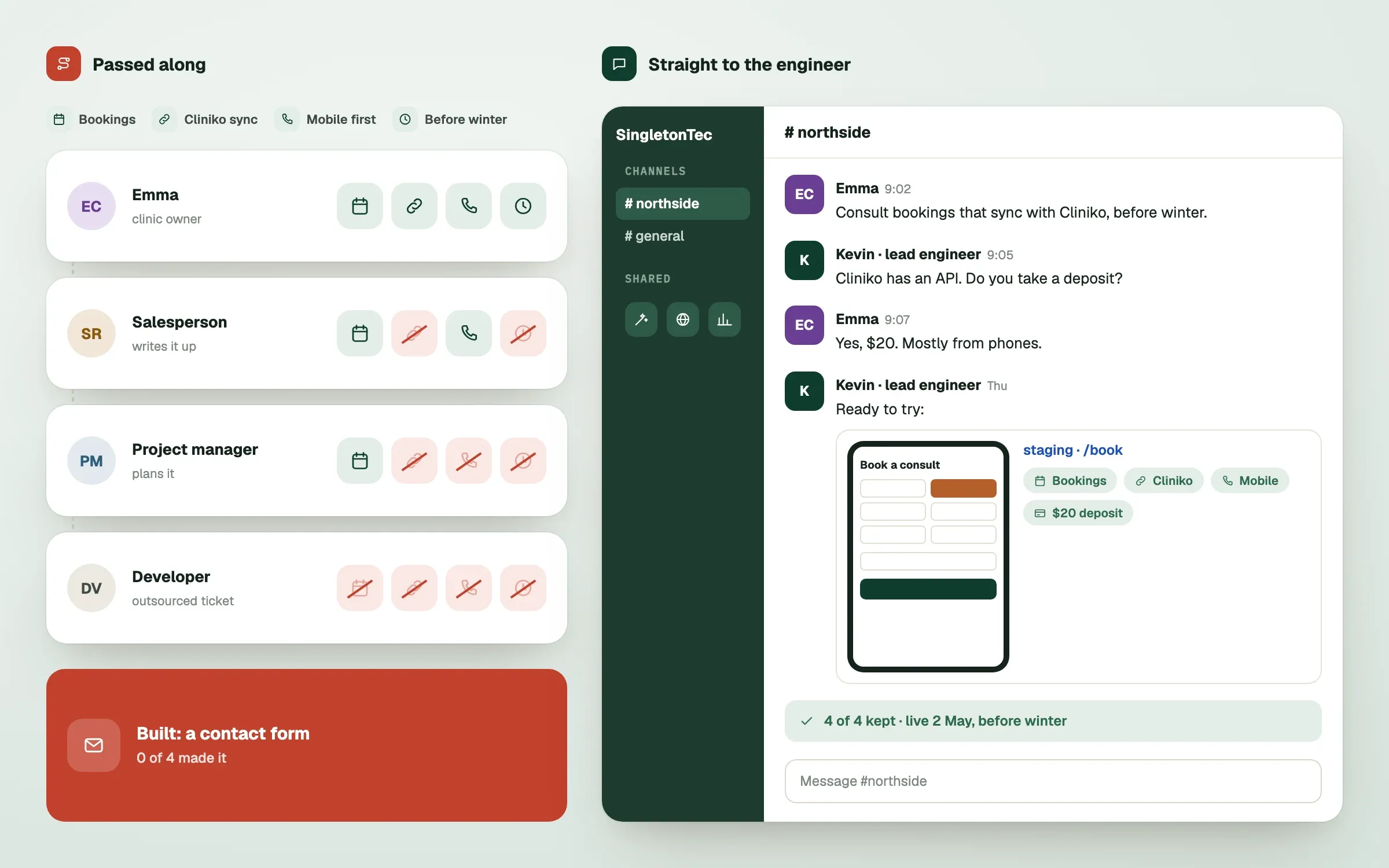
If you want a website, app or system that does what you pictured, you should be able to work directly with a web developer, or at least with the engineer who will lead the build. It sounds obvious. In most agencies I have worked in, it is not how things run. This read explains why that gap matters, what it costs you, and how to check an agency before you hire it. It is my view, formed over years inside agencies in the US, Australia and Canada.
Why does it matter who you talk to?
It matters because the person you talk to shapes the brief, and the brief shapes everything built from it. If that person does not understand how websites and software work, details get lost, guessed or invented before the work even begins.
A common pattern in the agencies we worked in: a salesperson meets you, hears your goals, and writes them up. They are good at conversation and they want the deal to go ahead, so a hard requirement can get softened or a promise can get made that the team cannot easily keep. Then the project reaches the builders and the surprises begin.
What gets lost when a brief is passed along?
Every handover loses something, and in many agencies a brief is handed over three or four times before a developer sees it. You can think of it like the party game where a message is whispered down a line of people. By the end, it is a different message.
Here are the things that most often go missing:
- Why you want something, not only what you asked for. The reason decides the best way to build it.
- The limits you mentioned in passing, such as a tool you already use or a rule you must follow.
- Technical trade-offs. A feature that sounds small can be a big job, and one that sounds hard can be simple.
- What you need first. Without that, everything gets built in the wrong order.
When the engineer is in the conversation from the first call, those details are caught while they are cheap to fix. When they appear later, they arrive as extra cost or delay.
What does an engineer ask that a salesperson does not?
An engineer asks questions that decide how the thing is built, because they will be the ones living with the answers. Our first question to every client is not about pages or features. It is: where do you see your brand in the next two years?
That one question changes the plan. A business that expects to open a second location, add online booking or launch an app needs a different foundation from one that wants a simple brochure site. From the answer we shape a plan, split the work into phases and set up more than one planned launch, so you get something live early and build from there.
Then come the practical questions. What tools do you already use? Who will update the content? What happens when a customer does something unexpected? These are not sales questions. They are engineering questions, and they are the ones that prevent expensive rework.
What does working directly with an engineer look like?
It looks like one named lead engineer assigned to you from the first call to launch, backed by the rest of the team. That is how we run SingletonTec. A lead engineer is the person you speak to, and behind them are other lead engineers, our in-house designers and our in-house marketing team.
I want to be clear about one thing, because it is easy to misread. Direct access does not mean one person does everything. No single person designs, builds, markets and supports a project well. It means you are never talking to a go-between who has to ask someone else the answer.
In practice you can expect:
- A plan written down and approved by you before any work starts.
- A shared Slack channel, so questions get answered in conversation instead of through tickets.
- Staging links, so you can see the site working before it goes live.
- Access to Figma, Google Analytics and Search Console, plus the documents we produce.
- A monthly report sent automatically at the end of each month.
When is a direct line not enough?
A direct line is not enough on its own, because access is only useful if the person on the other end is capable and accountable. Some freelancers give you direct access but carry no backup, so if they fall ill or leave, the project stalls. Some agencies give you a friendly contact who is, in fact, a relay.
The combination is what counts: a lead engineer who answers you directly, a team behind them so the project does not depend on one person, and a written plan that makes everyone accountable.
How can you check an agency gives you real access?
Ask a few direct questions before you sign, and watch whether the answers come from the person you would be working with.
| Question | A good sign |
|---|---|
| Will I speak with the person who builds my project? | Yes, from the first call, and they can name who it is |
| Who is behind them if they are unavailable? | A team, not an empty answer |
| How will we communicate during the project? | A named channel and a clear response expectation |
| Can I see work in progress? | Staging links and shared design files |
| Can the person on this call answer technical questions now? | They answer, or say they will confirm, without passing you on |
The best test is the first call itself. If the person you speak to can discuss how your project would actually be built, in words you understand, you are probably talking to the right person.
Finished this read?
- OpenedToday
- FinishedNot yet
Written by
Kevin MatthewsHead of Development
Kevin leads engineering at SingletonTec and has spent 10+ years building production-grade websites, apps and systems for businesses.