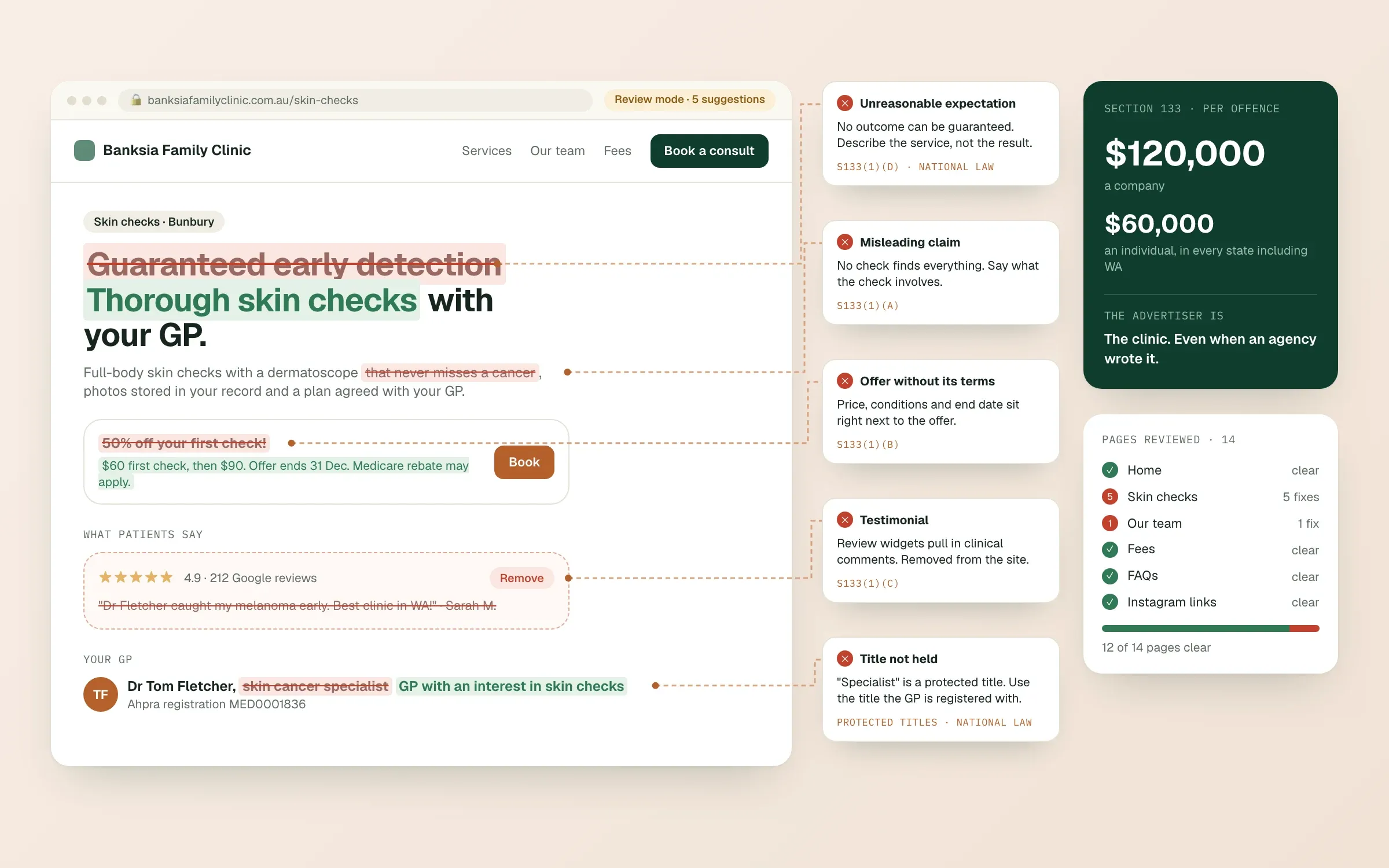
Ahpra's advertising rules are short. Section 133 of the Health Practitioner Regulation National Law has five prohibitions, and the Boards' joint guidelines explain them in about 40 pages. The hard part is applying them to a real website, where they touch everything from the homepage headline to a star-rating widget someone added two years ago. We build and audit clinic websites, so this read turns the rules into website requirements: what each one means, where it shows up, and what we build instead. It replaces our earlier read on this topic.
What does section 133 actually say?
Under the National Law, you must not advertise a regulated health service, or a business that provides one, in a way that:
- is false, misleading or deceptive, or likely to be
- offers a gift, discount or other inducement without stating its terms and conditions
- uses testimonials or purported testimonials about the service
- creates an unreasonable expectation of beneficial treatment
- directly or indirectly encourages the indiscriminate or unnecessary use of regulated health services
The guidelines explain each in detail, and a court can consider them when hearing an advertising offence.
Who counts as the advertiser?
Whoever controls the content. Ahpra's enforcement strategy treats the person or entity that authorises the advertising as responsible for it. For a clinic website, that's the clinic and its practitioners, not the agency that typed the words. We say this early in every project, because it changes how seriously people take the copy review.
The rules, page by page
| Rule | Where it shows up on a site | What we build instead |
|---|---|---|
| No misleading claims | Headlines ("Australia's leading"), stats with no source, "24/7" when support isn't | Specific, true statements: who you are, what you do, when you're available |
| Inducements need terms | Launch discounts, first-consult offers, referral rewards | Offers with full terms linked right next to them, or no offer at all |
| No testimonials | Google review widgets, star ratings, patient quotes, "success stories" | Information about the service, the practitioners and the process. See reviews and testimonials on clinic websites |
| No unreasonable expectations | "Guaranteed results", before-and-after galleries, outcome timelines | Plain descriptions of what's assessed and that outcomes vary |
| No encouraging unnecessary use | "Book now before it's too late", countdown timers, "limited spots", bundles that push more appointments | Clear booking with no urgency tactics |
Practitioner pages and titles
Practitioner profiles are advertising too, and they're where title rules bite. Only use a protected title, such as "specialist", "surgeon" or "nurse practitioner", for someone who actually holds it. The title "surgeon" has been restricted for medical practitioners since 2023. And never use badges like "Ahpra approved" or "Ahpra certified": Ahpra registers practitioners, it doesn't approve businesses or websites. Our read on practitioner profile pages covers names, registration and titles in detail.
Cosmetic clinics have extra rules
The Medical Board's guidelines for non-surgical cosmetic procedures add further advertising limits on top of section 133, covering imagery, before-and-after photos and how procedures are described. If you run a cosmetic clinic, read cosmetic clinic websites under the 2025 guidelines as well as this one.
What about prescription medicines?
Ahpra's rules cover the health service. The TGA's rules cover therapeutic goods, including a ban on advertising prescription-only medicines to the public. A clinic website has to satisfy both. Our TGA advertising rules read covers that side.
How we design the rules in
Copy reviews at the end catch some problems. Building the rules into the site catches more:
- No review or rating components in the design system. If the component doesn't exist, nobody can drop it onto a page.
- Offers have a required "terms" field in the CMS, and the page won't publish without it.
- Practitioner profiles pull titles and registration from one structured record, not free text.
- Service page templates have sections for who the service is for, who it isn't for, how it works and what to expect, which steers writers away from outcome claims.
- A pre-publish checklist in the CMS for anyone creating a page: no testimonials, no guarantees, no urgency, terms on offers, titles checked.
- Social and ad landing pages follow the same rules, because they're advertising too.
Want your current site reviewed against these rules? Start on Connect.
Sources
All checked 21 Nov 2026.
- Advertising and the law, Ahpra
- Guidelines for advertising a regulated health service, Ahpra
- Advertising a regulated health service, Medical Board of Australia
Finished this read?
- OpenedToday
- FinishedNot yet
Written by
Kevin MatthewsHead of Development
Kevin leads engineering at SingletonTec and has spent 10+ years building production-grade websites, apps and systems for businesses.