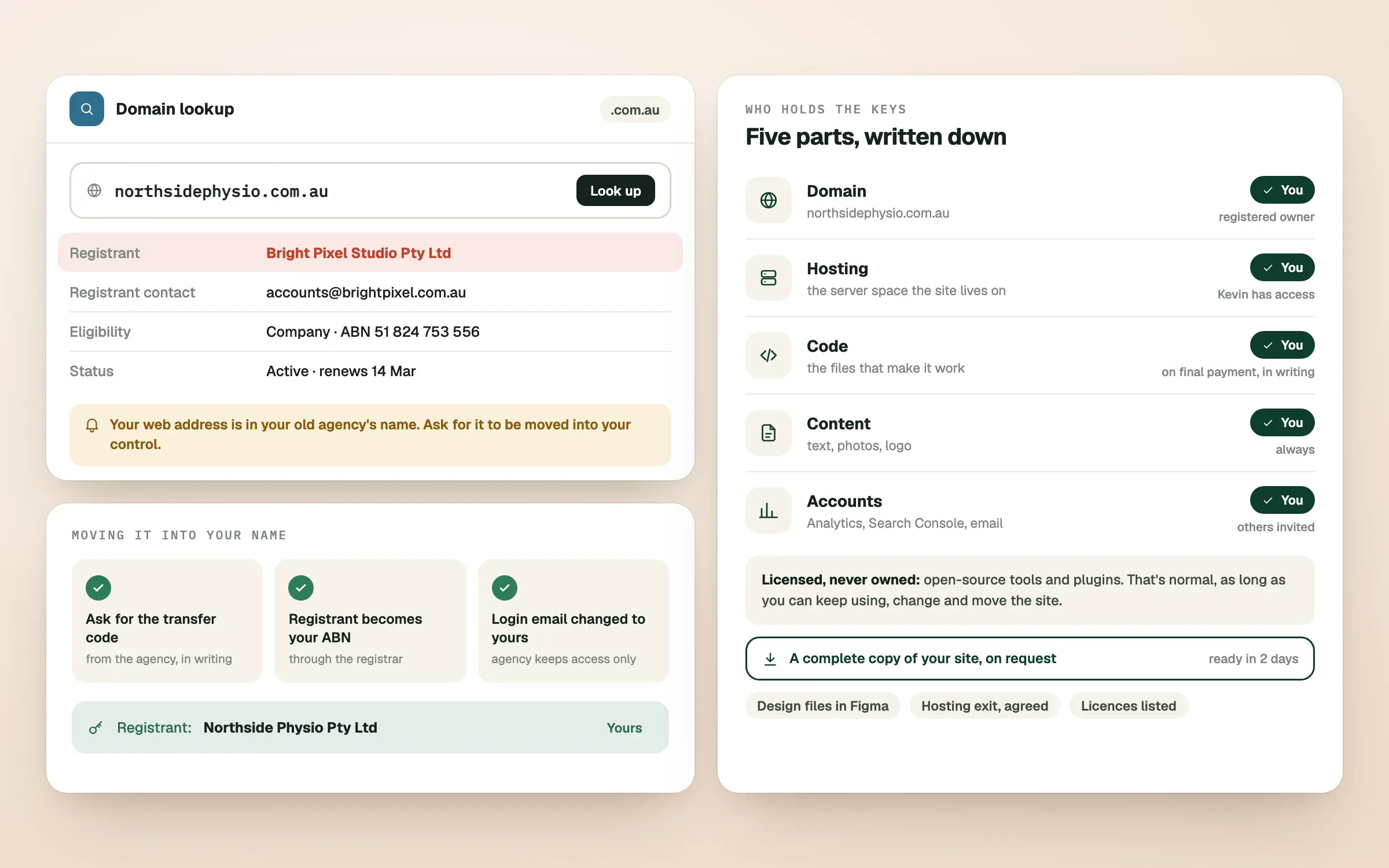
Who owns my website? The short answer is: it depends, because a website is made of five separate parts, and each can have a different owner. Those parts are the domain, the hosting, the code, the content and the accounts. Many business owners find out who owns what only when they want to leave an agency, and by then it can be awkward. This read explains each part in plain words so you can ask the right questions at the start. It is general information, not legal advice, so check anything important with a lawyer.
What are the five parts of a website, and who should own each?
You should own your domain, your content and your accounts outright, and the code and hosting should be agreed clearly in writing. Here is the overview.
| Part | What it is | Who should usually own it |
|---|---|---|
| Domain | Your web address, such as yourbusiness.com.au | You, as the registered owner |
| Hosting | The server space where your site lives | You hold the account, or it is clearly agreed |
| Code | The files that make the site work | Agreed in writing, with a licence at minimum |
| Content | Your text, photos, logo and products | You |
| Accounts | Logins for analytics, search, email and tools | You, with others given access |
Who should own your domain name?
You should, and you should hold the login. A domain is registered through a registrar (the company you buy it from), and one person or business is listed as the registrant, which means the legal owner. Some agencies register domains in their own name for convenience. It feels harmless until you fall out, the agency closes, or you want to move.
If the domain is in someone else's name, they control your address, your email and your search ranking. Some domain types have eligibility rules too. For example, .com.au domains are for businesses with an Australian connection, so check the current rules with the registry for the type you use.
Who owns your hosting?
Hosting should either be in your own account or clearly agreed. Hosting is the rented computer space where your site lives, with providers such as Cloudways, AWS, VentraIP, DigitalOcean or Vercel. There are three common setups.
- You pay the host directly and hold the account. The developer is given access. This is the cleanest for ownership.
- The agency pays the host and includes it in a monthly fee. It is convenient, but you should know what you would receive if you left, and how long it would take.
- The agency hosts many clients together on one server. This can be fine for cost, but your data is mixed with others, so ask how you would take a clean copy.
Any of these can work. The key is knowing the answer before you sign, not after.
Who owns the code?
This is the part most people have never thought about. Code is a creative work, and in Australia the creator generally owns the copyright unless it is transferred in writing. Paying for a website does not on its own transfer ownership of the code. As a general rule, a contractor who creates something owns the copyright unless the agreement says otherwise, though employment and specific contracts can change that, so check with a lawyer.
There are three typical outcomes:
- Full transfer: all rights to the custom code pass to you when you have paid in full.
- A licence: the developer keeps ownership and gives you a permanent right to use it for your business.
- A platform arrangement: your site runs on a platform such as Shopify, WordPress or a theme, where parts of the software are licensed from others and you never own them.
Who owns your content and your accounts?
You should own both, because they are yours to begin with. Your text, photos, logo, product data and customer information belong to your business. If a photographer, copywriter or designer made them for you, check that their agreements give you the right to use them on your site.
Accounts are the logins you depend on: Google Analytics, Google Search Console, your Google Business Profile, email, payment providers and design files. Make sure each is created under your business email, with the developer added as a user. It should never be the other way round. When accounts are shared with you from the start, such as design files, analytics and Search Console, there is nothing to hand over at the end because you already have it.
What should you get in writing?
Get the answers to these questions in the written plan before any work begins.
// checklist0 of 6 done
At SingletonTec the scope, terms and plan are written down and approved before any work starts, and that is the right moment to settle all of this. A good agency will answer these questions easily. If an answer is evasive, treat that as information.
Finished this read?
- OpenedToday
- FinishedNot yet
Written by
Kevin MatthewsHead of Development
Kevin leads engineering at SingletonTec and has spent 10+ years building production-grade websites, apps and systems for businesses.