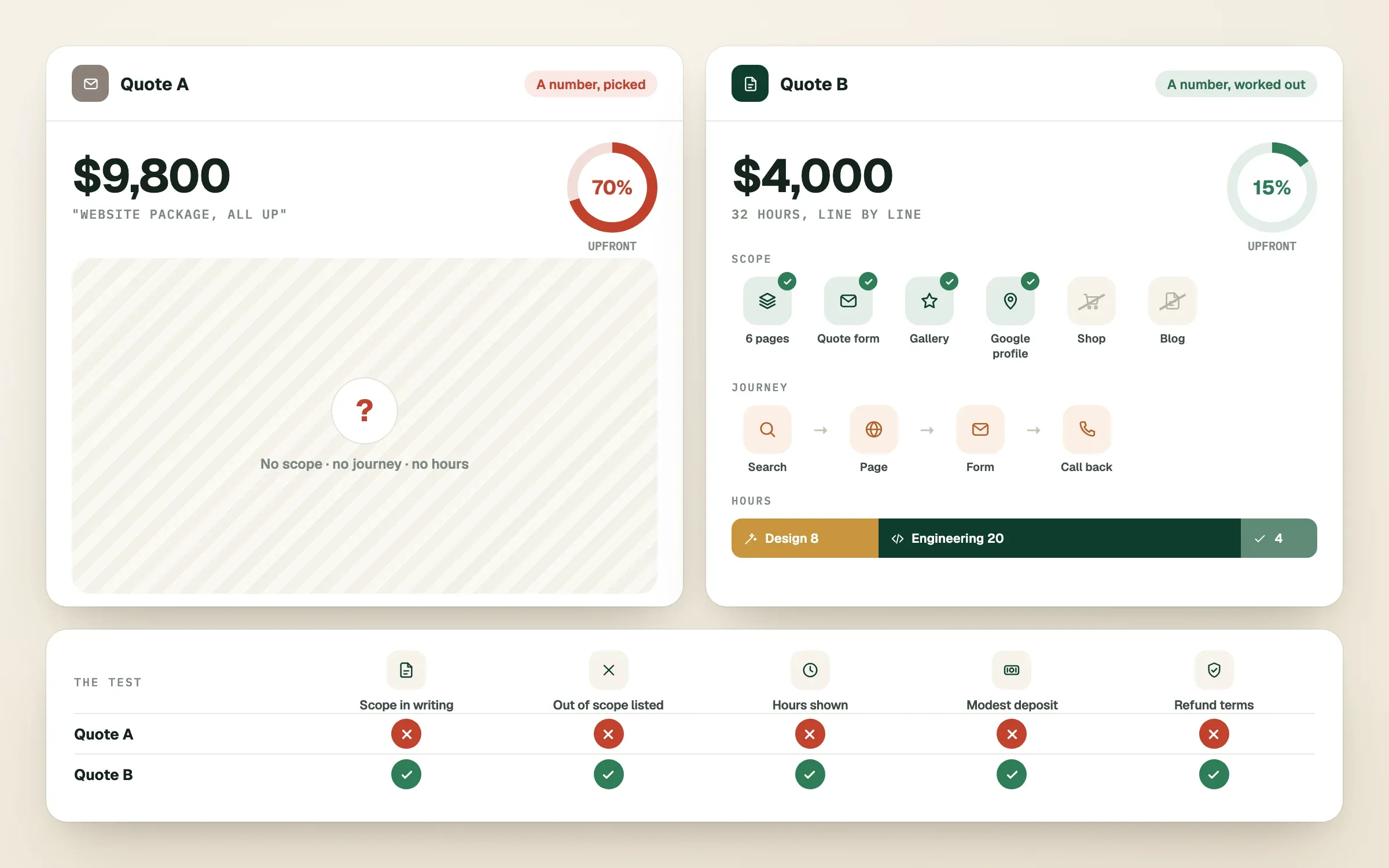
When you ask an agency "how much will it cost?", you rarely get an answer that explains itself. You get a number, a PDF and a follow-up call. This read is about how web agencies price projects, how I have seen it done from the inside, and what to ask so the number you sign has something solid behind it. It is my opinion, shaped by years in agencies, and it is general information rather than advice about any one company.
How do web agencies price projects?
Most agencies price in one of three ways: a fixed price for a fixed scope, an hourly or daily rate (often called time and materials), or a monthly retainer. Each can be fair or unfair. What matters is what sits behind the number.
| Model | How it works | Where it goes wrong |
|---|---|---|
| Fixed price | One price for an agreed list of work | Scope is vague, so every change becomes an extra charge |
| Hourly or daily rate | You pay for time actually spent | No ceiling, and no one tells you how many hours are left |
| Monthly retainer | A set monthly fee for ongoing work | Hours go unused, or the work is padded to fill them |
None of these is wrong on its own. A fixed price is only as good as the written scope behind it, and an hourly rate is only as good as the reporting you get.
Why do two agencies quote the same website so differently?
Quotes differ because the agencies differ in who does the scoping, who does the building, and how much risk they are pricing in. The website is rarely the main reason.
In agencies we worked in, a common pattern looked like this. A salesperson with no engineering background takes the brief. They describe it to a project manager, who describes it to a team lead, who describes it to the person who will actually write the code. By the time it reaches the builder, the brief has been retold three times and some of it has changed. In some cases the build is then outsourced to another company at a markup, and the price you see includes every layer it passed through.
The second pattern is bluff pricing. With no real estimate behind it, the number gets picked by guessing what the client might be willing to pay. Two clients with the same project can be quoted differently because one looked like they had a bigger budget.
What is a fair quote actually built from?
A fair quote is built from the scope, the features, the user journey, the effort and the engineering hours needed to deliver them. That is how we work at SingletonTec, and it is the test I would apply to anyone.
Here is what each part means in plain words:
- Scope: what is included and, just as importantly, what is not.
- Features: the specific things the site or app must do, such as online booking or payments.
- User journey: the path a visitor takes from arriving to becoming a customer. More paths and more complex paths mean more work.
- Effort and engineering hours: how long the build, testing and launch take for the people doing them.
From that comes one rule we hold ourselves to: same work, same price. Your budget, your company size and how keen you seem do not change the number. The plan is written down and approved by you before any work starts, so there is nothing to argue about later.
Why is a 60 to 70 percent deposit a red flag?
A very large upfront payment moves the risk from the agency to you, and it is worth asking why it is needed. In some of the agencies we worked in, taking 60 to 70 percent before any work was normal. It is not illegal, and sometimes an agency has a real reason. But once most of the money has been paid, the agency has less reason to hurry, and you have less leverage if things slip.
We take a 15 percent deposit, and the balance is due when the work is complete, before launch. If we cannot deliver the agreed scope, you get a full refund. That puts the pressure on us to deliver, which is where it belongs.
What should you ask any agency before you sign?
Six questions will tell you most of what you need to know, and a good agency will be glad you asked them.
| Question | What a good answer sounds like |
|---|---|
| Who will I speak to day to day? | A named person who understands the work, not only a salesperson |
| Who writes the code? | The people in the team, or a clear explanation if some work is outsourced |
| What is the deposit and why? | A modest deposit with a clear reason, and the balance tied to delivery |
| What is out of scope? | A written list, so there are no surprises later |
| Who owns everything when we finish? | You own your domain, content and accounts, with the terms in writing |
| What happens if you cannot deliver? | A clear refund or remedy, written down |
Where should you go from here?
Get at least two quotes, ask the same six questions of each, and compare the answers rather than only the totals. If you want to see how a quote is worked out from scope to hours, we are happy to walk you through ours, whether or not you hire us. An engineer, not a salesperson, will take the call.
Finished this read?
- OpenedToday
- FinishedNot yet
Written by
Kevin MatthewsHead of Development
Kevin leads engineering at SingletonTec and has spent 10+ years building production-grade websites, apps and systems for businesses.