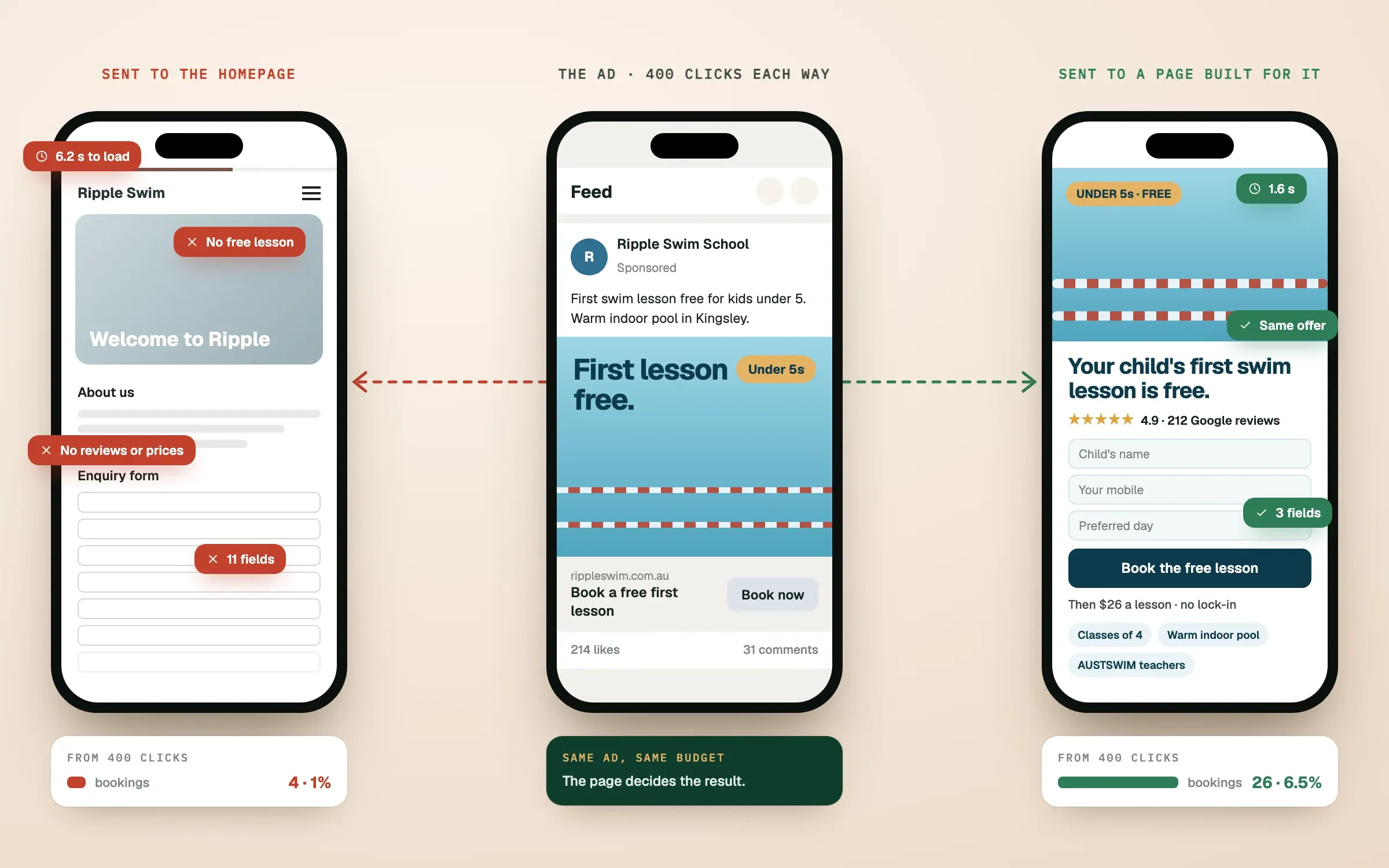
If you are paying for clicks and not getting customers, fix the page before you touch the ad. Conversion rate optimisation, often shortened to CRO, simply means making more of your visitors do the thing you want, such as calling, booking or buying. A landing page is the page a visitor arrives on after clicking your ad. A weak landing page is a very common reason good ads fail, and it is usually the cheapest thing to repair.
Is it really the page? Check your tracking first
Before you redesign anything, confirm the numbers are true. Many businesses discover their ads are working but their enquiries are not being counted.
Check that your phone-number taps, form submissions and bookings are recorded as results in Google Analytics and in your ad platform. Test it yourself: submit your own form, then see whether it appears. If you cannot see results, you cannot judge the page, and you may be about to fix something that is not broken.
Does the page match what the ad promised?
Message match means the page continues the promise made in the ad. If your ad says "Same-day emergency plumber" and the landing page opens with a general company story, people leave because it does not feel like what they clicked.
Make the page's headline repeat the ad's promise in nearly the same words. Show the offer, the area you serve and the next step above the fold, meaning without scrolling on a phone.
Is it fast, especially on a phone?
Most ad clicks come from phones, and people give a slow page very little patience. Test your page on a real phone using mobile data, not only on office wifi.
Common culprits are oversized images, auto-playing video, heavy chat widgets and scripts nobody uses. Shrinking images and removing extras often costs nothing and helps straight away.
Is there one clear action?
A landing page should do one job. If it offers a phone number, a form, a newsletter, three service links and a feed of recent posts, visitors are left to decide, and many decide to leave.
Pick the main action, such as "Request a quote", and make it obvious with a button that stands out and is repeated further down. Remove or quiet everything that pulls attention away, including the full site menu on dedicated ad pages.
Send ads to a page built for them
Your homepage is written for everyone, so it speaks to no one in particular. An ad for one service should land on a page about that service. If you promote five services, expect five focused pages to work better than one general one.
Does the page earn trust quickly?
A stranger from an ad has not met you yet, so the page has to answer "can I trust these people?" within seconds.
Table: Trust signals to put near your main button
| Signal | What to show |
|---|---|
| Reviews | Genuine reviews, with the source named |
| Credentials | Licences, registrations and memberships that are real and current |
| Clarity on price | A starting price or how pricing works, not "contact us" alone |
| Real people and places | Your actual team, premises or work, not generic stock photos |
| Guarantees | Only promises you will keep, stated plainly |
| Contact details | A real phone number and address, easy to find |
Is your form making it hard?
Every extra field loses some people. Ask only what you need to reply. Name, phone or email and a short message is enough for many businesses, and you can ask more once you are talking.
Make the button say what happens next, such as "Get my quote", rather than "Submit". Confirm what will happen after they send, and how quickly you will reply. Then actually reply quickly, because a fast response often matters more than a perfect page.
Does it work properly on a phone?
Open the page on a phone and try to complete the action with one thumb. Check that text is readable without zooming, buttons are big enough to tap, the phone number is tappable and the form works with the on-screen keyboard.
How does this fit with the rest of your marketing?
A good landing page makes every other channel more valuable, since search, social, email and ads all lead to pages. This is why we treat the ad, the page and the report as one job. A lead engineer builds the page, our marketing team runs the campaign, and you can see a staging link before anything goes live, plus a monthly report showing which changes moved the numbers.
Finished this read?
- OpenedToday
- FinishedNot yet
Written by
Umair NasirGrowth Analyst

Umair is SingletonTec's growth analyst. Umair reads the numbers behind websites and ad campaigns, finds where visitors drop off, and turns that into the next change worth making.