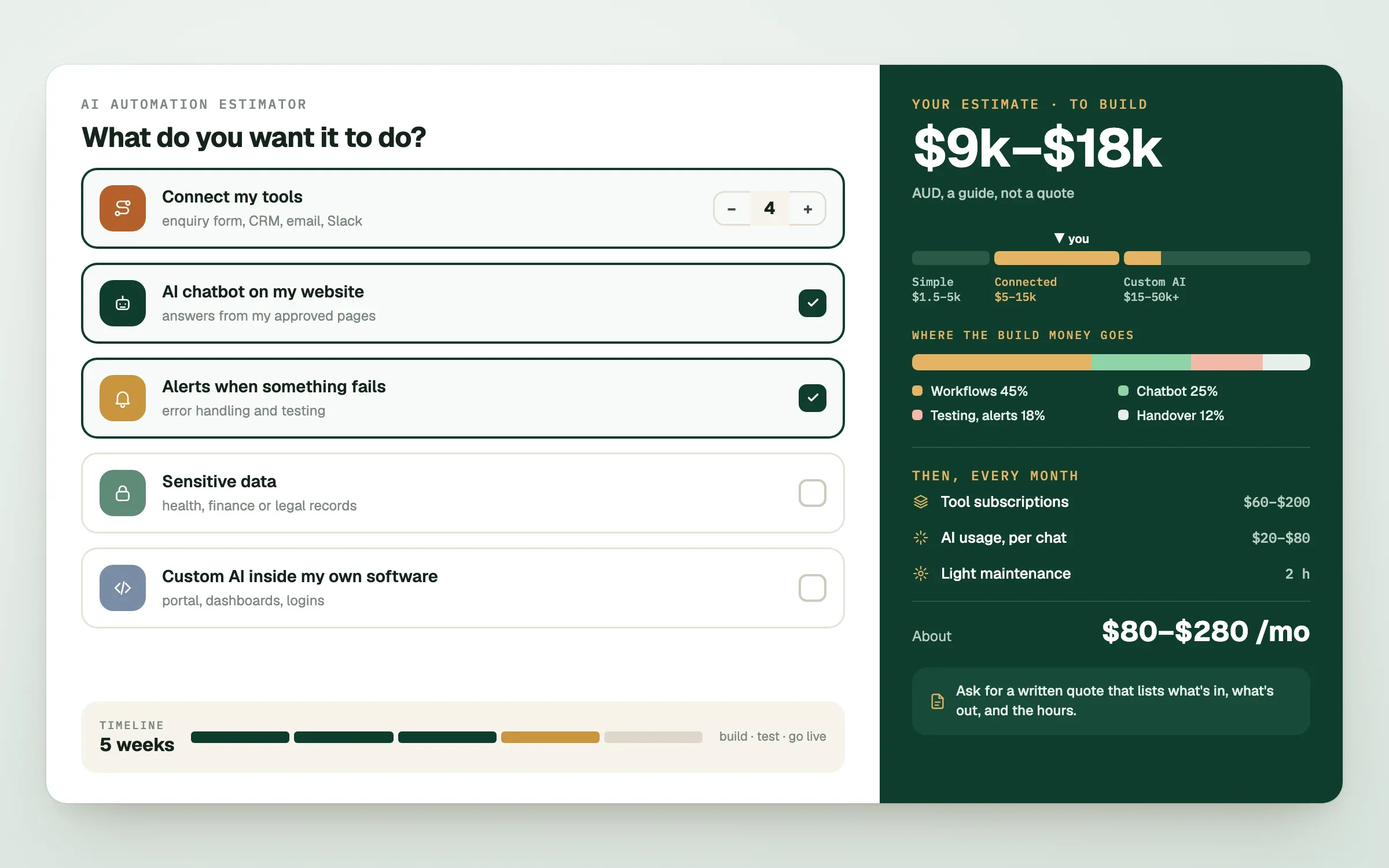
AI automation cost in Australia ranges from a few thousand dollars for a simple automation to tens of thousands for custom AI built into your own software. That is a wide range because "AI automation" covers very different jobs. This read gives you illustrative ranges as a guide, explains what moves the price, and shows what to look for in a quote so you can compare like with like.
What is the short answer on price?
The short answer is that a simple automation is a few thousand dollars, a connected workflow across several tools is more, and custom AI inside your own software is a larger project. These are illustrative ranges only. Real prices vary by supplier and by scope, so treat the numbers as a starting point for a conversation, not a quote.
| What you want | Typical range (AUD, a guide) | What it usually involves |
|---|---|---|
| A simple automation | $1,500 to $5,000 | One trigger, two or three steps, such as form to CRM to email |
| A connected workflow across several tools | $5,000 to $15,000 | Several systems, error handling, alerts and testing |
| An AI chatbot using your approved content | $4,000 to $15,000 | Content set-up, limits, hand-off to a person, review of conversations |
| Custom AI inside your own software or portal | $15,000 to $50,000 and above | Design, data handling, security, interface and testing |
What makes the price go up or down?
The price goes up with the number of tools involved, the amount of custom logic, the sensitivity of the data and the number of unusual cases the automation must handle. It goes down when the job is narrow, the tools are common and the rules are clear.
The factors that matter most:
- How many tools it connects. Linking a form to HubSpot is easier than linking a store, a stock system such as Cin7, a payment provider such as Stripe and your team's Slack channel.
- How much custom logic is needed. Ready-made connections are cheaper than rules written for the way your business works.
- How messy the data is. Clean, consistent data is quick to work with. Inconsistent data takes time to tidy first.
- How sensitive the information is. Health, financial and personal information need more care, more testing and stronger protection.
- The edge cases. An automation that handles the common case is quick. Handling the odd unusual cases is where hours go.
- Whether a person must approve steps. Building an approval screen is extra work, but it is often worth it.
What are the running costs after it is built?
After it is built, expect three ongoing costs: subscriptions to the tools involved, usage fees for any AI that is called, and a small amount of maintenance. These are easy to forget and they are the cost that surprises people most.
Subscriptions can range from nothing for simple tools up to a few hundred dollars a month for several paid plans, depending on what you choose. AI usage is often charged by how much text is processed, so a busy chatbot costs more than a quiet one. Maintenance covers the fixes that always come up eventually: an app changes its settings, a connection expires or your process changes.
Ask any supplier for an estimate of monthly running costs at your expected volume. If they cannot give one, that is worth noticing. Remember to check current vendor pricing, since it changes.
How should an honest quote look?
An honest quote is written, based on the real work involved, and clear about what is included. You should be able to read it and know what you are getting, what you are not, and how changes are handled.
Here is how we work at SingletonTec. We quote on scope, features, the user journey, effort and the engineering hours involved, so the same work costs the same price no matter who asks. We write the plan down and you approve it before any work starts. You speak directly with a lead engineer from the first call to launch, not a salesperson who passes things along. And because you own the result, the accounts and workflows sit in your name.
Red flags in an AI quote
- A single price with no description of what it covers
- "AI" promised everywhere, with no explanation of how it works or what it costs to run
- No mention of monthly or usage costs
- No plan for what happens when something fails
- Pressure to pay a large share upfront before the scope is agreed
- Nobody can explain, in plain words, who will actually build it
How do you keep costs under control?
You keep costs under control by starting small, fixing the scope in writing and measuring the result. A small first project gives you real numbers about time saved before you commit to a bigger one.
Three habits help. First, define the outcome in one sentence, such as "enquiries reach the right person within five minutes". Second, run the task by hand first so you know it is worth automating. Third, review the numbers after a month: hours saved, mistakes caught and running costs. If the automation does not pay for itself, you have a clear reason to change it or stop.
Finished this read?
- OpenedToday
- FinishedNot yet
Written by
Kevin MatthewsHead of Development
Kevin leads engineering at SingletonTec and has spent 10+ years building production-grade websites, apps and systems for businesses.