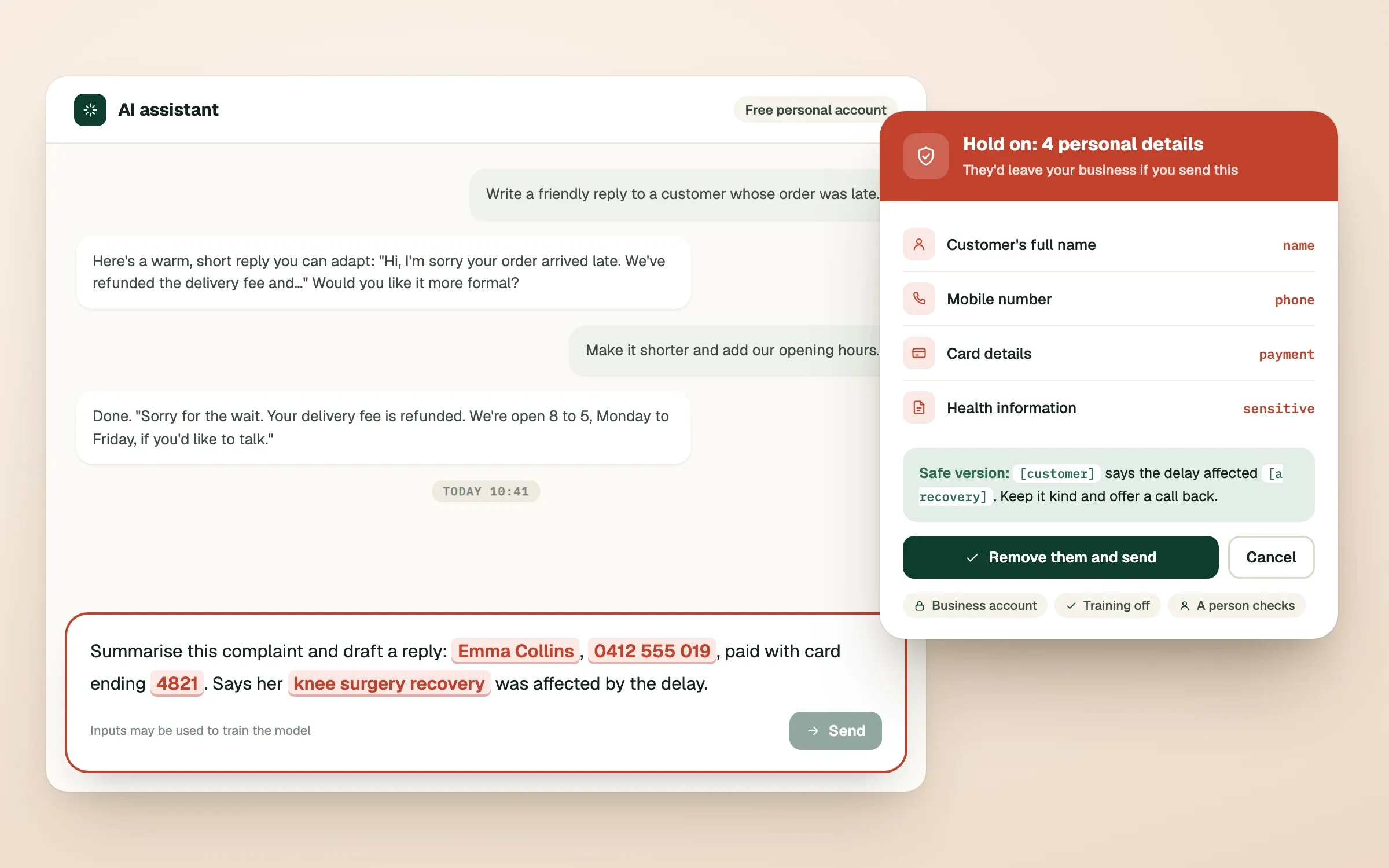
The short answer on ChatGPT privacy for business data in Australia is this: treat anything you paste into a public AI tool as information you have shared outside your business. Many staff already use these tools quietly to save time, which is understandable. The risk is not the tool itself. It is what gets pasted into it. This read explains what to keep out, what the rules say in plain words, and how to set a simple policy.
This is general information, not legal advice. Check the current rules or speak to a qualified adviser about your situation.
Why does pasting into ChatGPT matter for privacy?
It matters because the text you paste leaves your systems and goes to a third party. Depending on the product, the plan and the settings, that provider may store it, review it or use it to improve their service. Consumer and free versions generally have fewer protections than business plans, and the rules differ between vendors and can change.
Think of it like emailing a document to a stranger who promises to be careful. The stranger may be very trustworthy. You still would not send them your customer list without a good reason and an agreement in place.
What should you never paste into a public AI tool?
Never paste personal information about customers or staff, health details, financial details, passwords, or confidential business documents into a tool you have not checked. A good test is whether you would be comfortable seeing the text on a public noticeboard.
| Kind of information | Examples | Should it go into a public AI tool? |
|---|---|---|
| Safe | Your own public website copy, generic questions, ideas, made-up examples | Yes |
| Think first | Draft emails with names removed, internal process notes, anonymised numbers | Only if properly stripped of identifying detail |
| Never | Customer names with contact details, patient or health information, bank or card details, passwords and access keys, signed contracts, staff records | No |
What does Australian privacy law say, in plain words?
In plain words, if your business handles personal information, you have duties to protect it, and putting it into an AI tool does not remove them. The main law is the Privacy Act 1988, which contains the Australian Privacy Principles (APPs). They cover how you collect, use, disclose and secure personal information.
Two practical points come up for small businesses.
First, the Act has historically exempted many small businesses, those under a certain annual turnover. That exemption does not apply to everyone. Health service providers are covered whatever their size, and so are businesses that trade in personal information, among other cases. Reforms have also been under discussion, so do not assume the exemption protects you. Check the current position with the Office of the Australian Information Commissioner (OAIC).
Second, the OAIC has published guidance on using commercially available AI products. It advises caution about entering personal information into publicly available tools, and recommends considering the privacy position before using AI at all. That guidance reflects the way the law applies to AI today, and it is worth reading before you roll anything out.
How do you use AI safely at work?
You use AI safely by agreeing a few simple rules, choosing business-grade tools, and keeping sensitive data out of the rest. You do not need a thick policy. One page that everybody reads will do more than a long one nobody opens.
A one-page staff policy that works
// checklist0 of 7 done
When we build AI features into a website or app, privacy is part of the plan from the start: what data goes in, where it is stored, who can see it and how it is protected. We agree that with you in writing before building, rather than discovering it afterwards.
What if someone has already pasted something sensitive?
If someone has already pasted something sensitive, act quickly and calmly. Do not blame the person: the aim is to learn and fix it.
Work out what was shared, which tool received it and what account it was under. Delete the conversation where you can, and check whether the tool offers a way to remove stored data. Change any password or key that was exposed straight away. If personal information may have been accessed or disclosed in a way that could cause serious harm, you may have obligations under the Notifiable Data Breaches scheme, so seek advice promptly and check the current OAIC guidance. Then update your policy so it does not happen again.
Finished this read?
- OpenedToday
- FinishedNot yet
Written by
Kevin MatthewsHead of Development
Kevin leads engineering at SingletonTec and has spent 10+ years building production-grade websites, apps and systems for businesses.