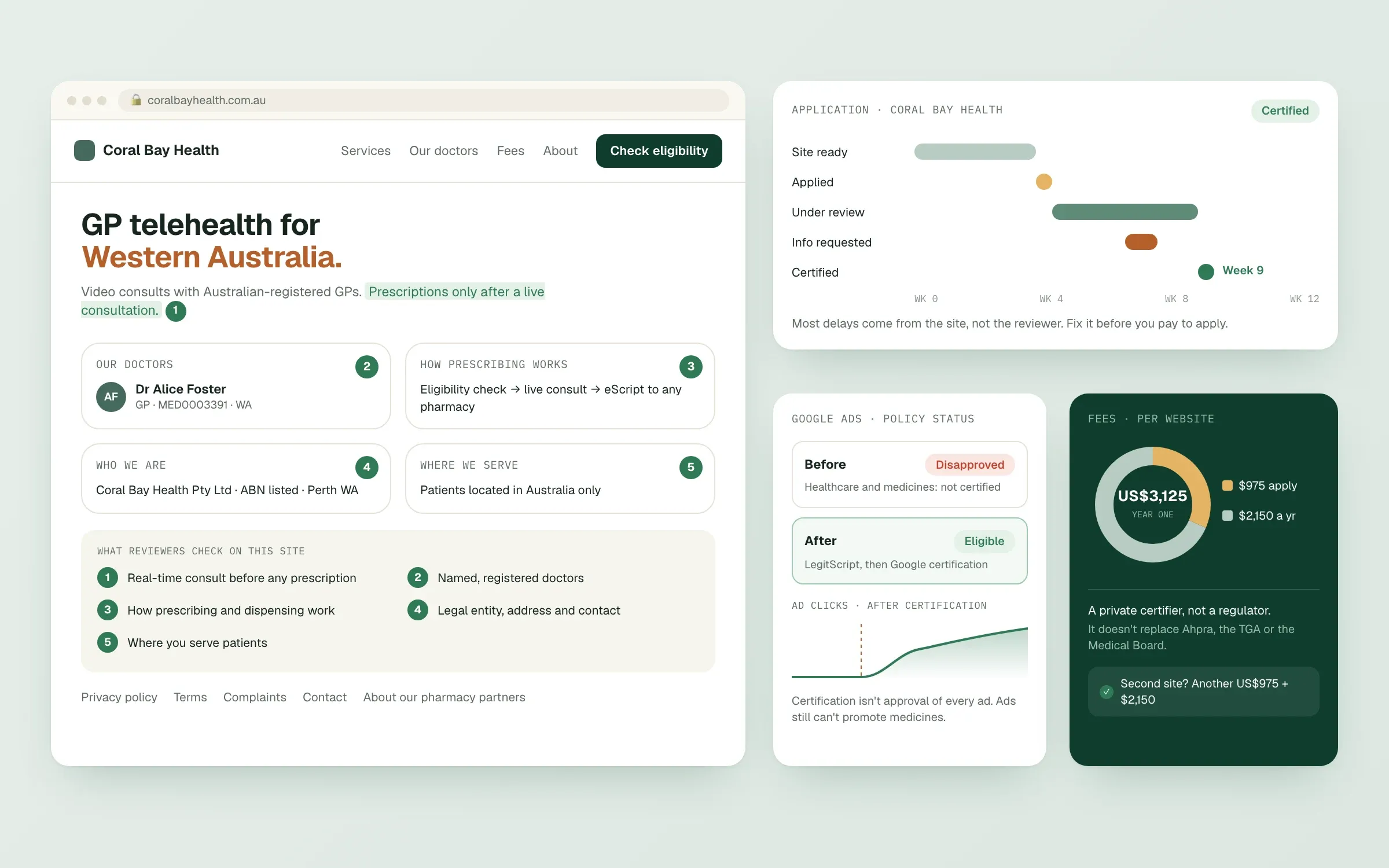
If your telehealth clinic wants to run Google Ads in Australia, you need LegitScript certification first. Google's healthcare policy for Australia only allows telemedicine providers to advertise if LegitScript's Healthcare Merchant Certification Program has verified them, and it restricts prescription drug terms in ads and landing pages either way. LegitScript reviews your business, your partners and, above all, your website. We build and fix clinic websites so they are ready for that review, so this read covers what certification means in practice, what it costs, where Australian clinics get stuck and what to have in place before you apply.
What is LegitScript, and why does an Australian clinic need it?
LegitScript is a US-based company that certifies healthcare businesses so that advertising platforms and payment networks can trust them. Google, Meta, Microsoft, TikTok, Visa and Mastercard all recognise its Healthcare Merchant Certification. For an Australian telehealth clinic, the reason it matters is almost always Google Ads.
Google Ads
Google's Australian rules allow telemedicine providers to advertise only if they are verified by LegitScript, and you also have to apply for Google's own healthcare certification once LegitScript approves you. If you run telehealth ads without it, they get disapproved.
Meta (Facebook and Instagram)
Meta requires telehealth providers to hold LegitScript certification before promoting prescription drugs, and it only allows prescription drug ads in the United States, Canada and New Zealand. Its policy does allow ads that promote telehealth services generally without written authorisation. In practice, Australian clinics can promote "see a doctor online" on Meta, but never a medicine, whether certified or not.
Payments
Visa and Mastercard recognise LegitScript certification, which can help with approval for card-not-present payments. Some payment providers ask for it when a clinic's account is flagged as high-risk healthcare.
What LegitScript is not
It is not a regulator and not a licence to operate. Certification says an independent reviewer checked your business against LegitScript's standards at a point in time. It does not mean Ahpra, the TGA or the Medical Board approved anything.
That distinction matters on your website. Under Ahpra's advertising rules, implying an endorsement you do not have is misleading. Show the LegitScript seal the way LegitScript intends, linked to your public verification page, and never write "government approved", "TGA approved" or "Ahpra approved" next to it.
Which Australian clinics need it?
You almost certainly need it if you run a telehealth service that prescribes medicines and you want to advertise on Google. That covers most GP telehealth, weight management, men's and women's health, skin, peptide and medical cannabis clinics.
| Your situation | Do you need LegitScript? |
|---|---|
| Telehealth clinic that prescribes, wants Google Ads | Yes, before ads will run |
| Online pharmacy wanting Google Ads | Yes, or meet Google's state pharmacy registration alternative |
| Telehealth clinic using Meta ads for general "see a doctor online" messages only | Not for those ads; Meta allows general telehealth promotion |
| Clinic that only runs organic search, no paid ads | Not for ads; some payment providers may still ask |
| Physical clinic advertising in-person appointments, no online prescribing | Usually not; check Google's policy for your services |
If you are unsure, the fastest test is to submit one ad: if Google flags it under its healthcare and medicines policy, you need certification.
What does it cost, and how long does it take?
Certification is priced per website: a one-off application fee and an annual fee once you are approved.
| Item | Cost (as of 21 Nov 2026) |
|---|---|
| Application fee | US$975 per website, non-refundable |
| Expedited review (optional) | US$2,500 extra per application; review starts within 2 business days |
| Annual certification fee | US$2,150 per website, due once approved |
| First-year total | US$3,125 per website (US$5,625 if expedited) |
Each domain you want certified needs its own fees, and you must disclose every domain you operate even if you only certify one. If you run a separate site per service line, that adds up quickly, which is one reason we usually build one clinic domain with service sections rather than several microsites.
LegitScript lists telemedicine as one of the more complex business models to review, so expect questions rather than a quick yes. The biggest time saver is a complete application: LegitScript notes that applications saved half-finished take longer to review. After approval, certification runs for a year, renews annually and is monitored throughout.
What do LegitScript reviewers check?
They check your business, your partners and your website against LegitScript's core certification standards. In plain words, these are the nine listed on its healthcare certification page:
| Standard | What it means for an Australian telehealth clinic |
|---|---|
| 1. Licensure and business registration | Your business registration and the registration of every prescribing practitioner, for every place you serve |
| 2. Legal compliance | Your site and services follow Australian law, and you do not facilitate unapproved medicines |
| 3. Prior discipline and history | You disclose 10 years of legal and regulatory history for the business, principals and practitioners |
| 4. Affiliates and partners | Partner pharmacies, co-owned businesses and suppliers also meet the standards; you disclose every domain |
| 5. Patient services | Your site clearly states where your services are available |
| 6. Privacy | A privacy policy that meets local law, and sensitive data sent over encrypted connections |
| 7. Valid prescription | No prescribing before care from a licensed practitioner, and telehealth rules followed |
| 8. Transparency | Accurate, non-misleading claims about practitioners, pharmacies, treatments and money |
| 9. Advertising | Ads that are accurate, lawful and within each platform's policy |
Our LegitScript requirements checklist turns each standard into the specific pages and features reviewers look for.
Where do Australian clinics get stuck?
In the applications we help prepare, the delays rarely come from the website itself. They come from things the website reveals.
Partner pharmacies
LegitScript generally requires partner pharmacies, the ones that dispense your patients' prescriptions, to be LegitScript-certified or accredited by another recognised body such as the US-based NABP. A partner that is not certified must apply within 60 days of your certification, and its outcome can affect yours. Many Australian compounding pharmacies have never heard of LegitScript, so start that conversation early.
Unapproved medicines
Standard 2 says a certified business must not facilitate medicines that lack approval from the relevant regulator, and the application checklist names "impermissible peptides" as a common barrier. Peptide and longevity clinics should expect detailed questions about what is prescribed and how it is sourced.
Practitioner details
Reviewers ask for practitioner registration numbers in a telemedicine template. If your site lists practitioners who no longer work with you, or none at all, expect questions. Keep a single source of truth for who prescribes and make sure the website matches it.
A US privacy policy template
LegitScript asks for a privacy policy that complies with your country's law; for US merchants that means HIPAA. We still see Australian clinic sites running US templates that mention HIPAA and not the Australian Privacy Principles. Replace it before applying.
A site that is not finished
If the site is still being built, LegitScript asks for wireframes or screenshots and a completion date. It also asks for a working test patient account so reviewers can see the portal. Applying before the booking and patient flows actually work usually means a slower review.
What do we build before a clinic applies?
We treat "LegitScript-ready" as a launch requirement on telehealth builds, because fixing it after the application starts costs review time. These are the items we put in place:
- Legal entity and ABN in the footer, Terms and Privacy Policy, matching the ABN register exactly.
- Practitioner pages with names and Ahpra registration, kept in the CMS so one update changes every page.
- A service-area statement such as "We provide telehealth services to patients located in Australia" on service pages, the Terms and the booking flow.
- An Australian privacy policy with named processors and overseas disclosure, plus consent before any tracking.
- HTTPS everywhere, including booking, portal and payment pages.
- A consult-first booking flow, where every pathway ends in a real-time consultation and nothing implies a questionnaire alone leads to a prescription. Our read on booking flows that meet Medical Board guidelines explains why.
- Factual partner pharmacy wording, such as "Prescriptions are dispensed by Australian-registered pharmacies", with no promotion of the pharmacy.
- Landing pages with no prescription drug terms, ready for Google review.
- A test patient account on the live system, with dummy data, ready to hand to reviewers.
- One canonical domain, with old domains redirected and listed in the application.
After certification: why ads can still be disapproved
Certification gets you permission to advertise, not approval of every ad. LegitScript itself says certification is not a free pass for advertising. The most common reasons we see certified Australian clinics still hit disapprovals are prescription drug names in landing page copy, URLs or image alt text, and service pages that read as promoting a medicine rather than a consultation. Our read on Google Ads for telehealth clinics covers landing page builds.
LegitScript also monitors certified businesses throughout the year, so a new service line, a new partner pharmacy or a redesign can trigger questions. Treat any of those changes as a reason to re-check the site before it goes live.
Sources
All checked 21 Nov 2026.
- Healthcare and medicines policy: Australia update, Google Ads
- Update to Healthcare and Medicines Policy: Restricted Drug Terms (October 2025), Google Ads
- Drugs and pharmaceuticals ad standards, Meta
- Healthcare certification: standards, pricing and partners, LegitScript
- Healthcare application checklist (PDF), LegitScript
Finished this read?
- OpenedToday
- FinishedNot yet
Written by
Kevin MatthewsHead of Development
Kevin leads engineering at SingletonTec and has spent 10+ years building production-grade websites, apps and systems for businesses.